


In our Tenorshare 4DDiG review, we’re taking a practical look at the software from the angle most people care about: can it recover files, is it easy to use, does the price make sense.
We’ll test it across key categories like recovery power, features, value, and user feedback, scoring each one from 1 to 5. Once that’s done, we’ll combine the scores into a final rating so you can tell at a glance whether 4DDiG deserves a spot on your shortlist.
📌 Here’s our brief summary:
Tenorshare 4DDiG is a user-friendly data recovery tool that performs well in everyday data loss cases. It offers a wide feature list – disk imaging, repair tools, crashed PC recovery, and specialized scan modes – though some of those extras feel lighter in practice than they appear on paper. Pricing is competitive on Windows, less appealing on Mac. Our final take: a solid mainstream choice for regular users, while more advanced options still feel deeper and more refined for serious recovery work.
| 👍 Strengths | 👎 Weaknesses |
|---|---|
|
|
🔎 Why You Can Trust Us:
Every app review is the result of a hands-on, multi-step process run by team experts. Our QA specialists run recovery tests on real drives. Then, lab engineers verify the results to make sure every text is accurate. Experienced technical editors present the results in a clear, reader‑friendly format.
Tenorshare 4DDiG Overview
Tenorshare is a software development company that has focused on designing data recovery and security systems. It has developed a lightweight data recovery software that retrieves data from various sources. Some of the main features of Tenorshare Data Recovery are:
| Key Feature | Details |
| 💻 Available Platforms | Windows 11/10/8.1/8/7, Windows Server (varies by build), macOS 10.13 or later |
| 🆓 Free Version | Yes. Free scan, preview, and limited recovery quota (2 GB). |
| 📄 Supported File Types | 2,000+ file types claimed, including photos, videos, documents, archives, audio, and email files |
| 💽 File System Support | NTFS, FAT32, exFAT, FAT16, APFS, HFS+, ext2/ext3/ext4 |
| 🌐 NAS/RAID Support | Basic support for some RAID/NAS scenarios if drives are directly accessible or mounted. (Not as advanced as dedicated forensic tools) |
| 🧱 Disk Image Creation / Scanning | Yes. Can create and scan disk images in supported formats |
| 🔍 Recovery Method | Quick scan + deep scan |
| 🧰 Extra Tools | Corrupted video repair, photo repair, bootable recovery media, crashed PC recovery, duplicate file cleanup tools (varies by edition) |
| 📞 Customer Support | Email support, help center, refunds under stated conditions |
OS and File System Support

4DDiG does a solid job when it comes to platform coverage. The main desktop version supports Windows and macOS, which already covers the vast majority of people looking for recovery software.
Windows support stretches across older versions through Windows 11, and there are builds aimed at Windows Server environments as well.
On the Mac side, it supports modern Intel and Apple Silicon systems, which matters now that many users have moved to M-series machines.
File system support is also broad:
- On Windows, you get the standards most people need: NTFS, FAT32, exFAT, and older FAT variants often found on USB drives and SD cards.
- On macOS, it supports APFS and HFS+, so both newer Macs and older machines are covered. Linux file systems like ext2, ext3, and ext4 are listed too.
Camera Recovery
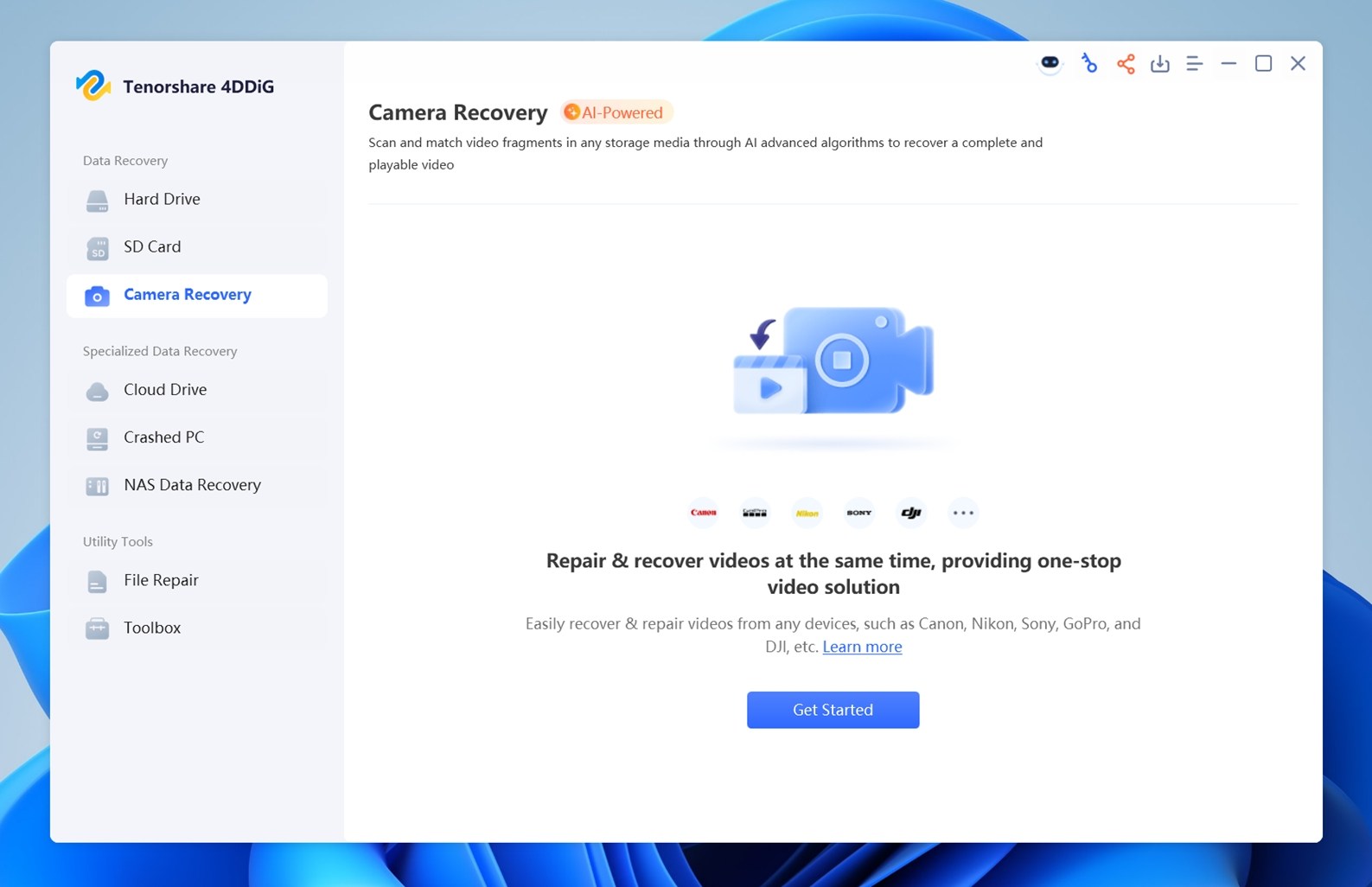
4DDiG includes a dedicated Camera Recovery mode aimed at action cams, DSLRs, drones, and other media devices. It’s labeled AI-powered, which sounds nice in the interface, though this kind of claim usually deserves a little caution. In practice, it most likely means the software uses automated matching and reconstruction logic for fragmented video files, not some new recovery method. That still can be useful, especially with broken or incomplete clips from SD cards, but we would treat the AI label as marketing first and a technical advantage second.
The real question is whether it rebuilds damaged footage better than the standard scan.
Crashed PC Recovery
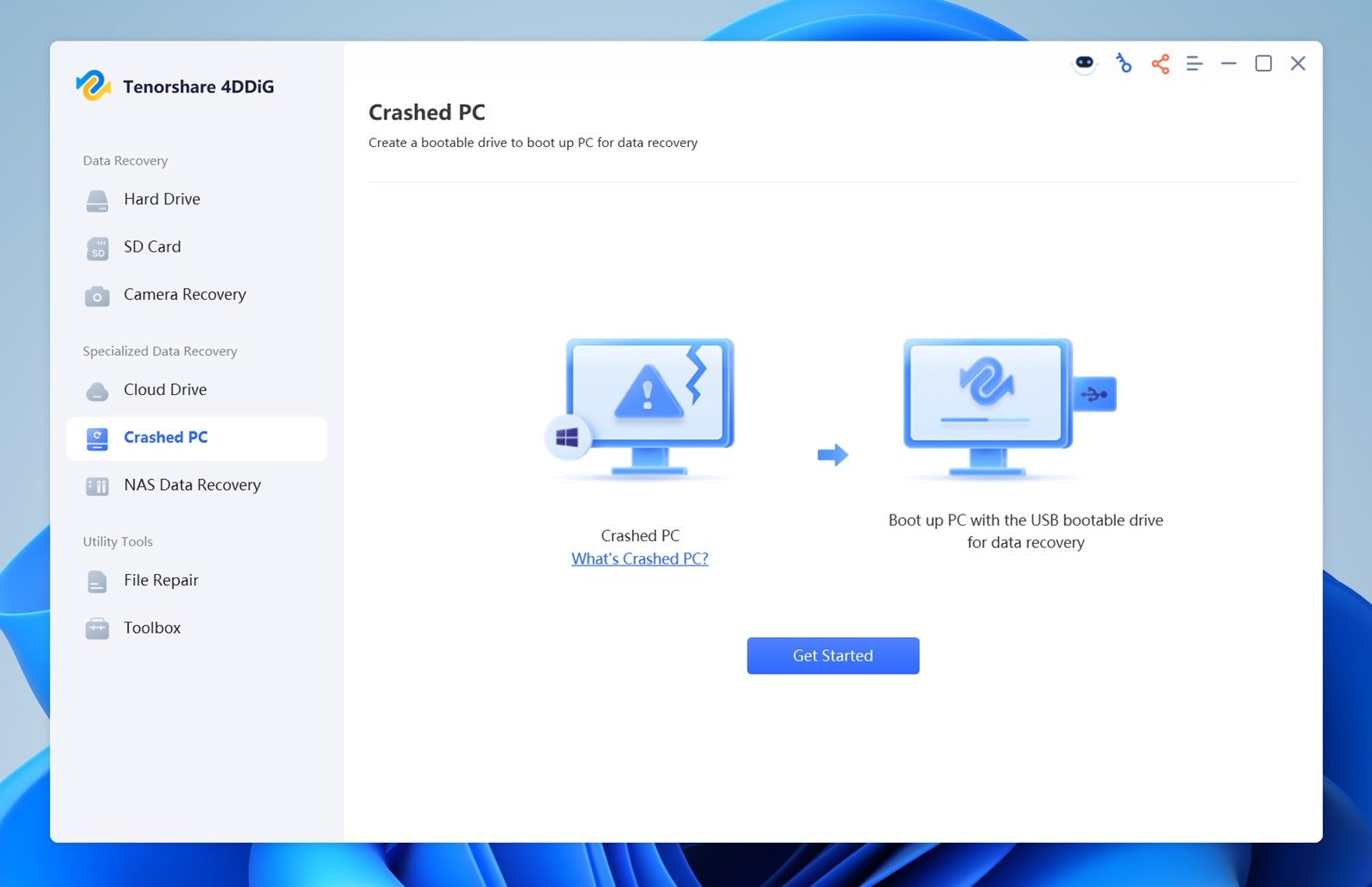
There’s also a Crashed PC module that helps create a bootable USB drive. You use it to start a Windows machine that no longer boots, then recover files from the internal drive. For users facing a blue screen or startup loop, this can be one of the more practical extras in the suite.
Disk Image Support
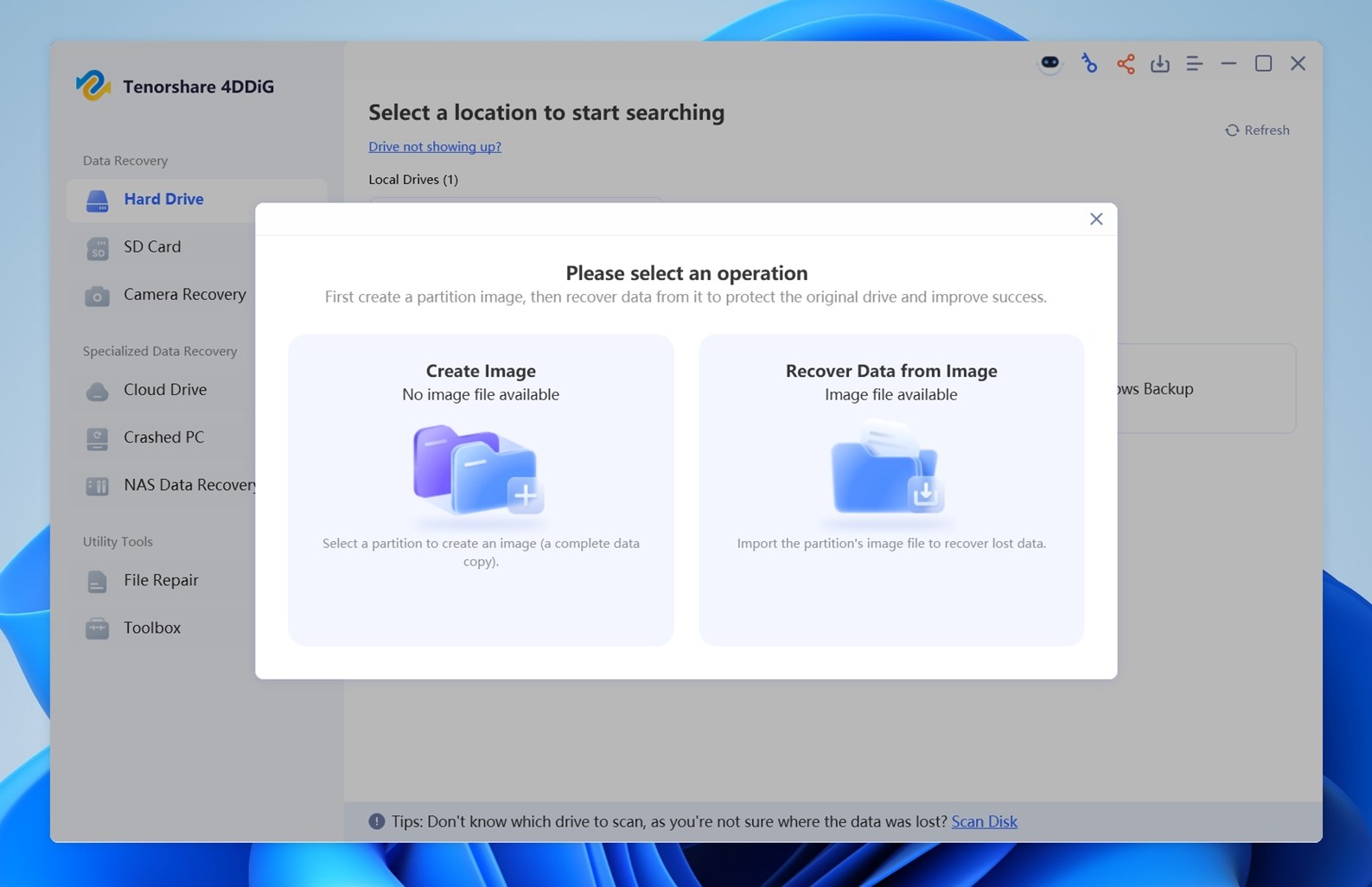
4DDiG supports creating and scanning disk images, which is a must for unstable drives. Instead of stressing failing hardware with repeated scans, you can clone the device first and work from the image file.
That is the safer workflow in many data loss cases. We’d count the absence of this feature as a major drawback in any recovery tool, so it’s good to see it included here.
NAS Data Recovery
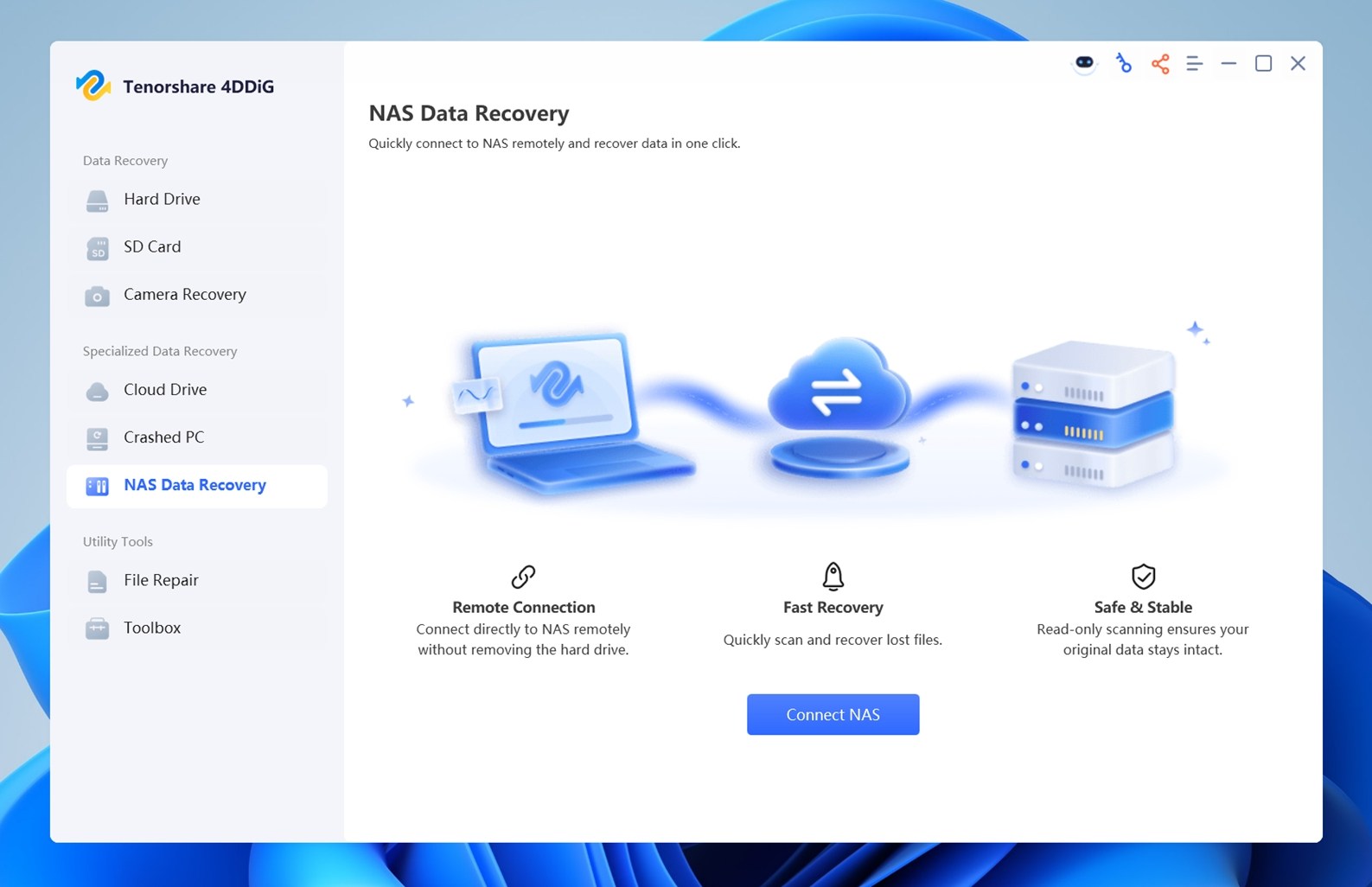
The NAS Recovery section is designed for remote access to network storage devices. It aims to scan data without removing drives from the enclosure. That convenience matters for home users and small offices who don’t want to dismantle a NAS box to begin recovery.
File Repair Tools
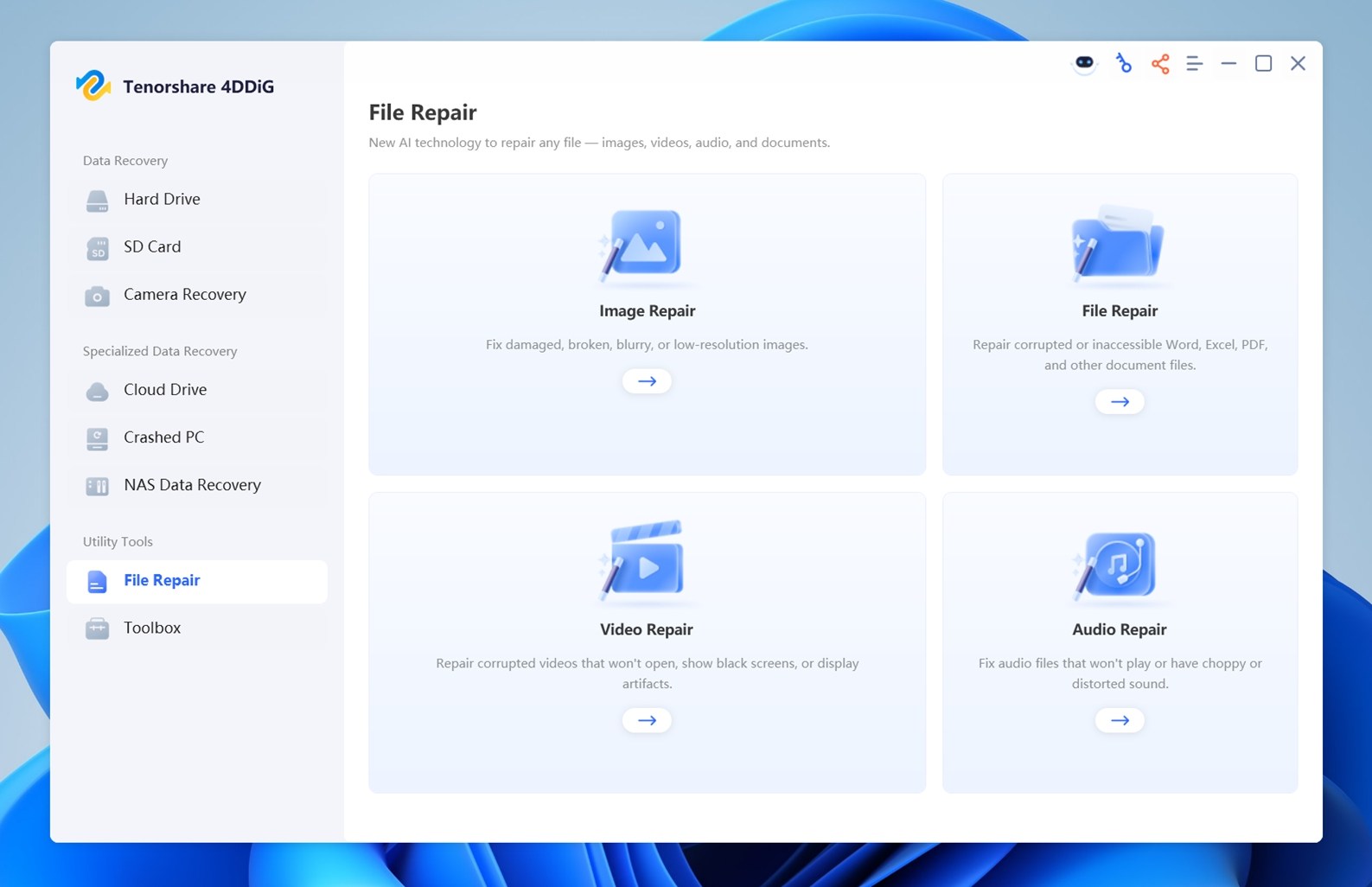
Inside the File Repair area, you’ll find separate tools for damaged photos, videos, audio, and documents. Think blurry JPEGs, corrupted Word files, black-screen videos, or broken audio tracks. Results vary depending on damage level, but it’s useful to have repair tools built into the same package.
Interface and User Experience
One of the most noticeable features of Tenorshare is its elegantly designed user interface. It is easy to navigate and user-friendly. You don’t require any specific skill-set or experience level to use the software. Moreover, there is a guide available on the Tenorshare website to help acquaint users with the interface.
The home screen lays out common targets: internal drives, USB devices, Recycle Bin, Desktop, folders, and disk images. Obvious.
Navigation on the left side groups tools into logical sections like Data Recovery, Specialized Recovery, Repair, and Toolbox. It feels organized.
Time for the first score in this Tenorshare 4DDiG review. On features, 4DDiG comes in strong. It covers the basics well: broad file system support, recovery from common storage devices, disk image creation, bootable recovery, NAS tools, media-specific recovery modes, and built-in repair utilities. That is a wide toolkit, especially for home users who want one app that handles multiple problems.
The UI also helps here. Features are organized clearly, so the software does not feel like a cluttered toolbox.
Why not a full 5? Some parts of the feature set lean too hard on marketing language, and a few tools are not as deep as we’d like. NAS support, for example, is fairly basic compared to more advanced recovery software. And while the UI is clean and easy to understand, some parts of the actual experience hold it back a bit (especially the slow preview behavior).
How to Recover Data with Tenorshare
Now we get to the part that usually matters most: how 4DDiG performs once you stop reading feature lists and start using it on an actual machine.
We’ll walk through our hands-on time with the software, including setup, scan behavior, recovery speed, and overall workflow. We also put it through common data loss scenarios like deleted files, formatted media, and removable drives with mixed file types.
But before we get into the step-by-step testing experience, here’s a quick summary of how 4DDiG performed across our recovery scenarios. This is meant as a snapshot, more details a bit later.
| Test Case | Deleted Files / Formatted Drive | Corrupted Drive |
| Scanning Time | 12 min | 16 min |
| Total Data Recovered | ~1.92 GB | ~1.61 GB |
| Total Files Recovered | 185 | 156 |
| Documents Recovered | 58 | 49 |
| Photos Recovered | 96 | 81 |
| Videos Recovered | 24 | 18 |
| Archives / Other Files | 7 | 8 |
Testing Process
To get a fair sense of how 4DDiG performs, we used the same kind of scenarios we’ve run many times when reviewing recovery software: deleted files, a quick-formatted drive, a storage device with file system corruption. Common cases. They also reveal quickly whether a tool is polished or mostly marketing.
Our test setup was straightforward:
- OS: Windows 11 Pro
- CPU: Intel Core i5 (12th Gen)
- RAM: 16 GB
- System Drive: 1 TB NVMe SSD
- Test Device: Kingston 16GB USB 3.0 flash drive
- Test Data: Around 200 mixed files (DOCX, PDF, JPG, PNG, MP4, MOV, MP3, ZIP, plus some RAW photos)
We intentionally used the kinds of files people usually care about: photos, work docs, videos, and media folders. Then we added a few larger and messier files (RAW photos) to see how the software handled tougher jobs.
For the corruption test, we damaged the file system so Windows could detect the device but could not open it normally.
Data Recovery Workflow
Now let’s look at what a typical recovery session with 4DDiG actually looks like:
- Download the Tenorshare 4DDiG software installation file from the Tenorshare website. Choose the file suitable for your system, install, and launch the application.
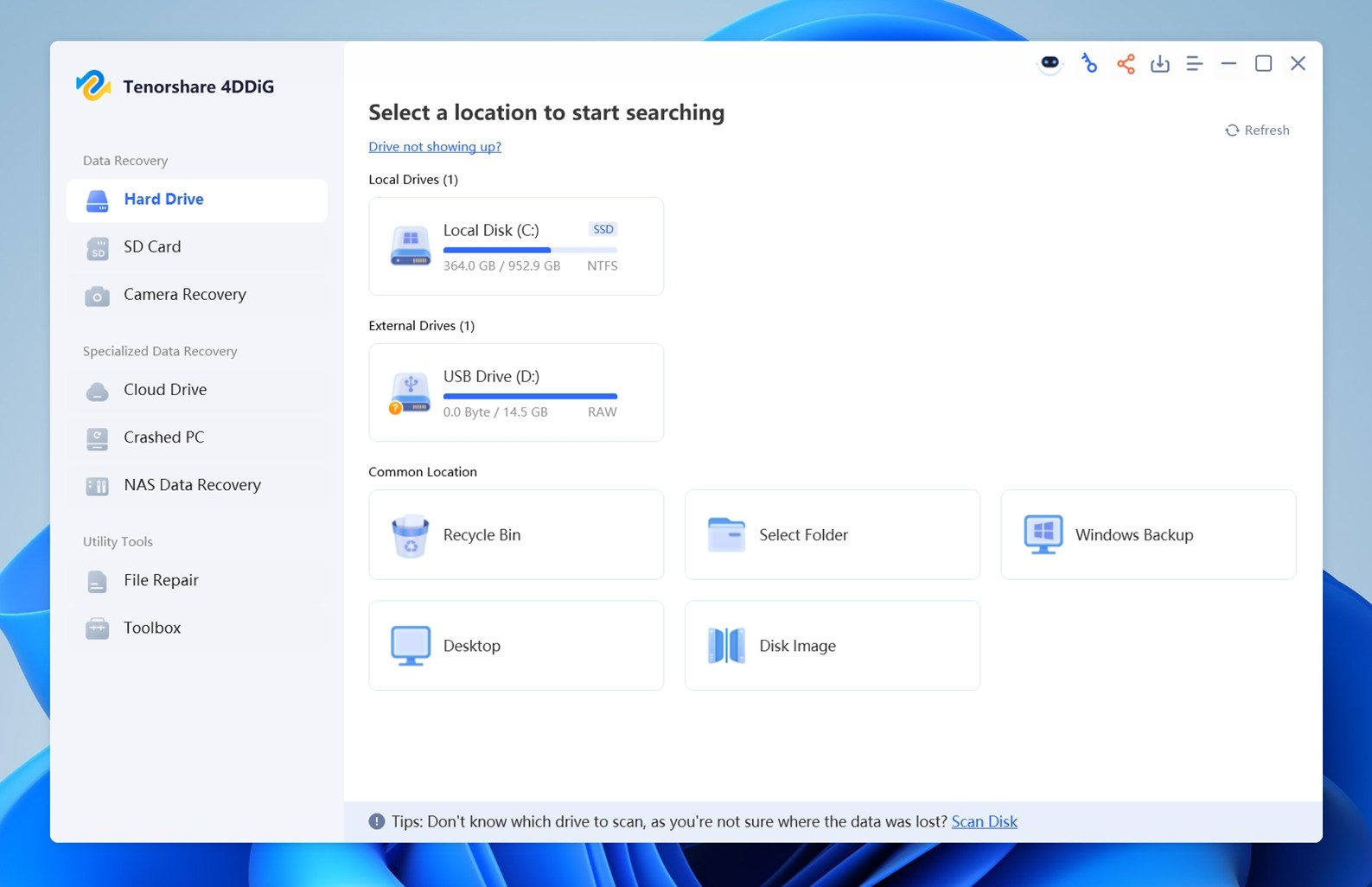
- At the top, you’ll see local and external drives. Under that, 4DDiG also lists quick-access targets like Recycle Bin, Desktop, Select Folder, Windows Backup, and Disk Image. In our case, the damaged USB drive showed up as a RAW volume. So the first move is simple: click the drive or location where the data was lost.
- After that, 4DDiG opens a file type selection window.
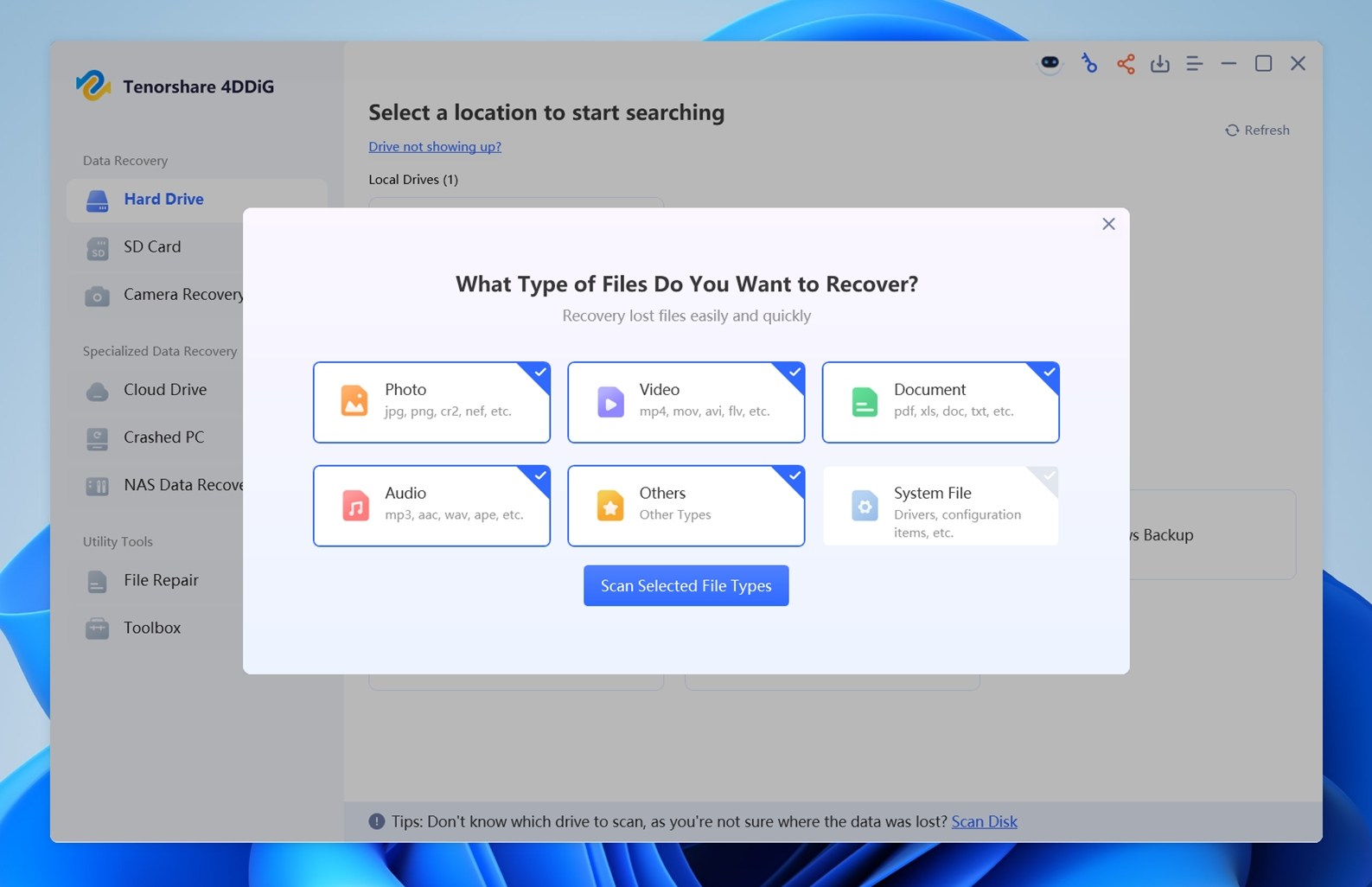 Here you can narrow the scan to Photos, Videos, Documents, Audio, or Other file categories. If you already know what you’re after, this can save time. (For example, if you only need deleted JPGs or MP4s from an SD card, it makes sense to leave the rest unchecked.) In our case, we selected multiple categories to better reflect a real mixed-data recovery case, then clicked Scan Selected File Types.
 - Once the scan begins, the interface shifts into the results view.
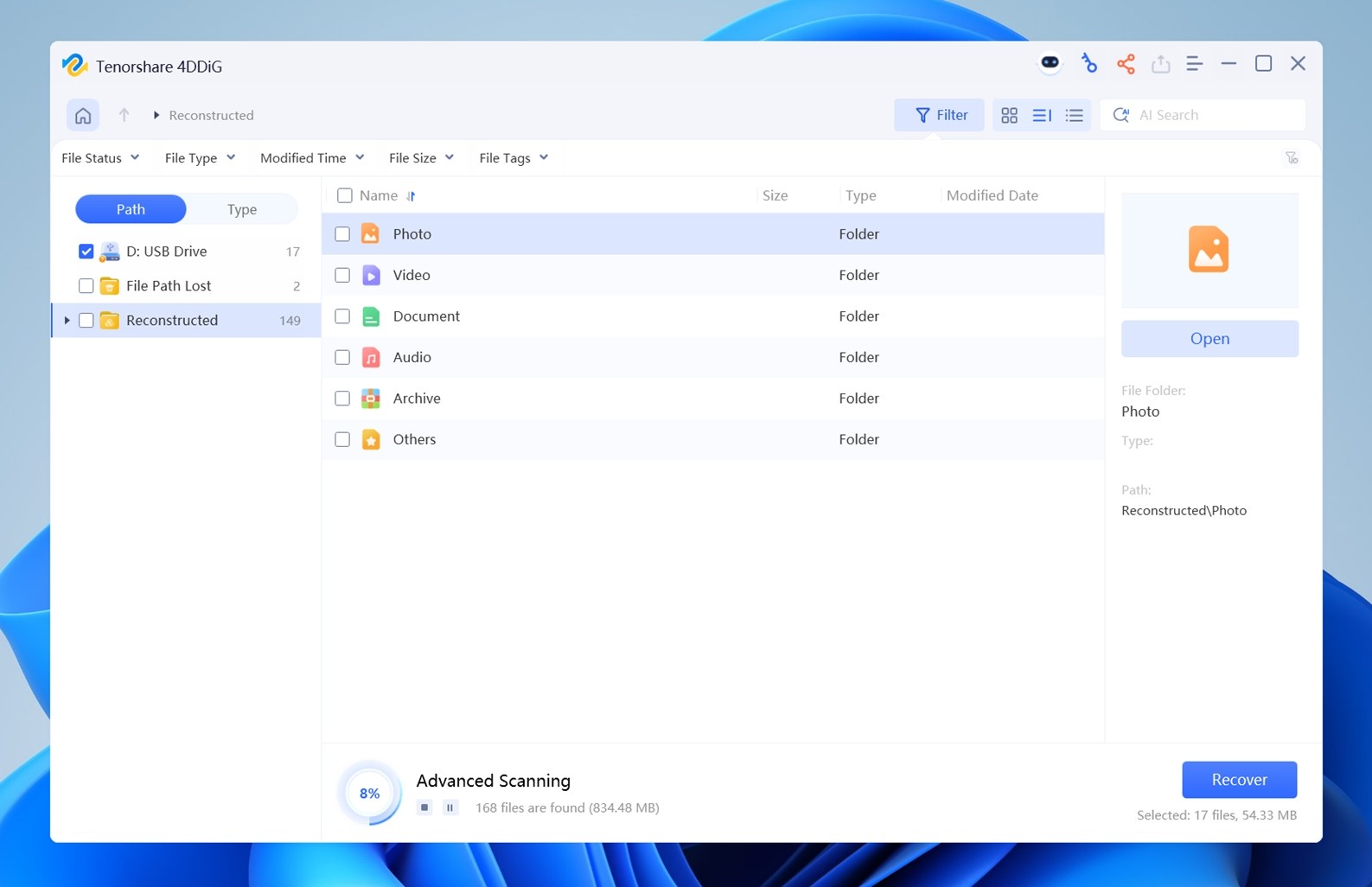 On the left, you get a folder tree with categories like the original drive, File Path Lost, and Reconstructed. That split is useful. If 4DDiG can still read enough file system metadata, you may find files in their original (or semi-original) paths. If not, it sorts them into reconstructed groups by type, such as Photo, Video, Document, Audio, Archive, and Others.
 - The main file list sits in the center. This is where you browse filenames, sizes, types, and modification dates.
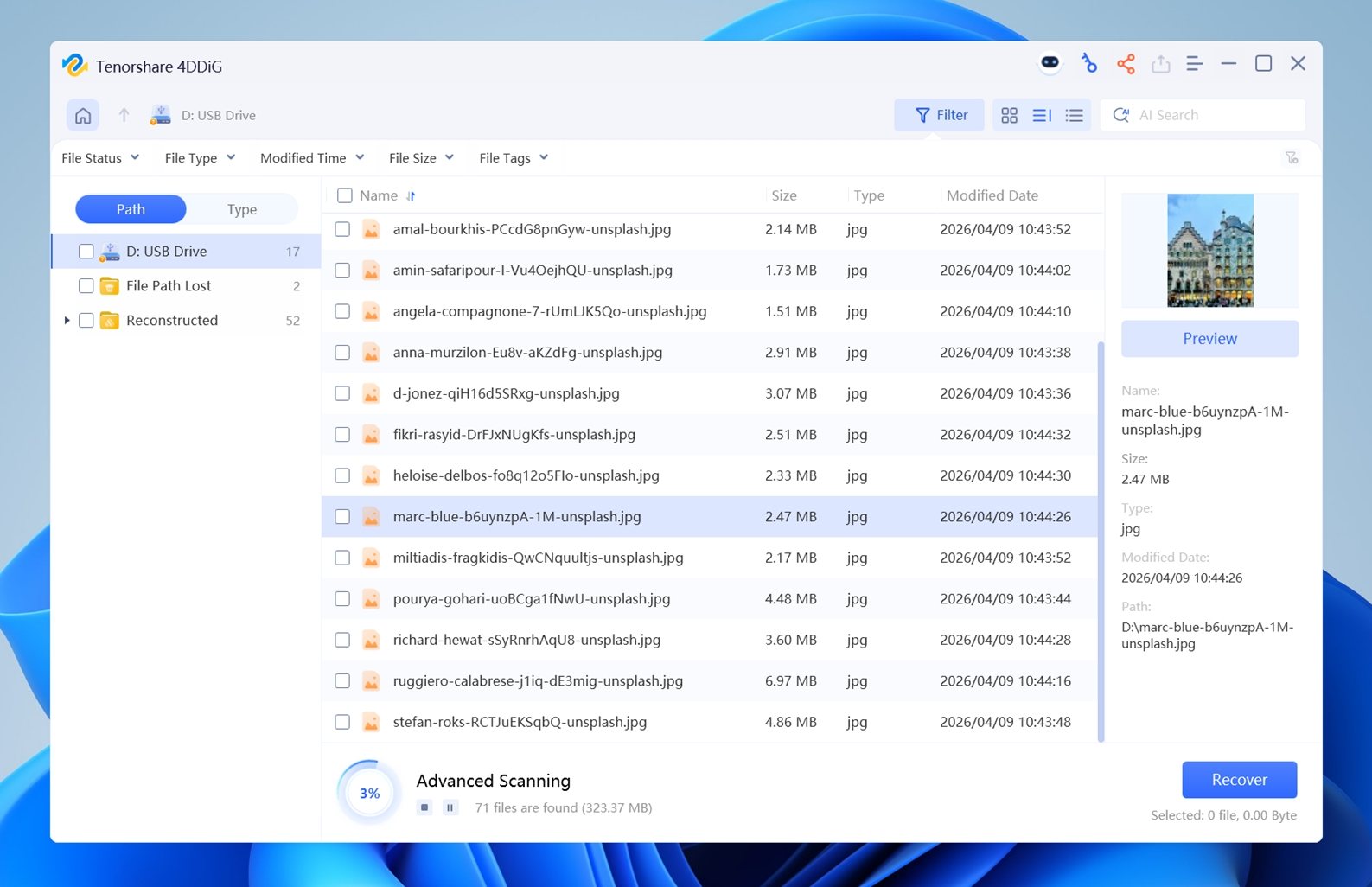 Across the top, there are filters for file status, file type, modified time, file size, tags. There’s also a search bar on the upper right.
 - On the right side, 4DDiG shows a preview pane. Click a file and you’ll see a thumbnail there, along with a Preview button. Sadly, this is one of the weaker parts of the experience. Previews can be painfully slow, so you often have to sit and wait instead of quickly checking file after file.
- Once the scan ends, 4DDiG shows a completion dialog and leaves you in the results view, where you can start selecting files for recovery. At that point, the final step is the standard one: check the files you want, click Recover in the bottom right corner, and save them somewhere other than the source drive.
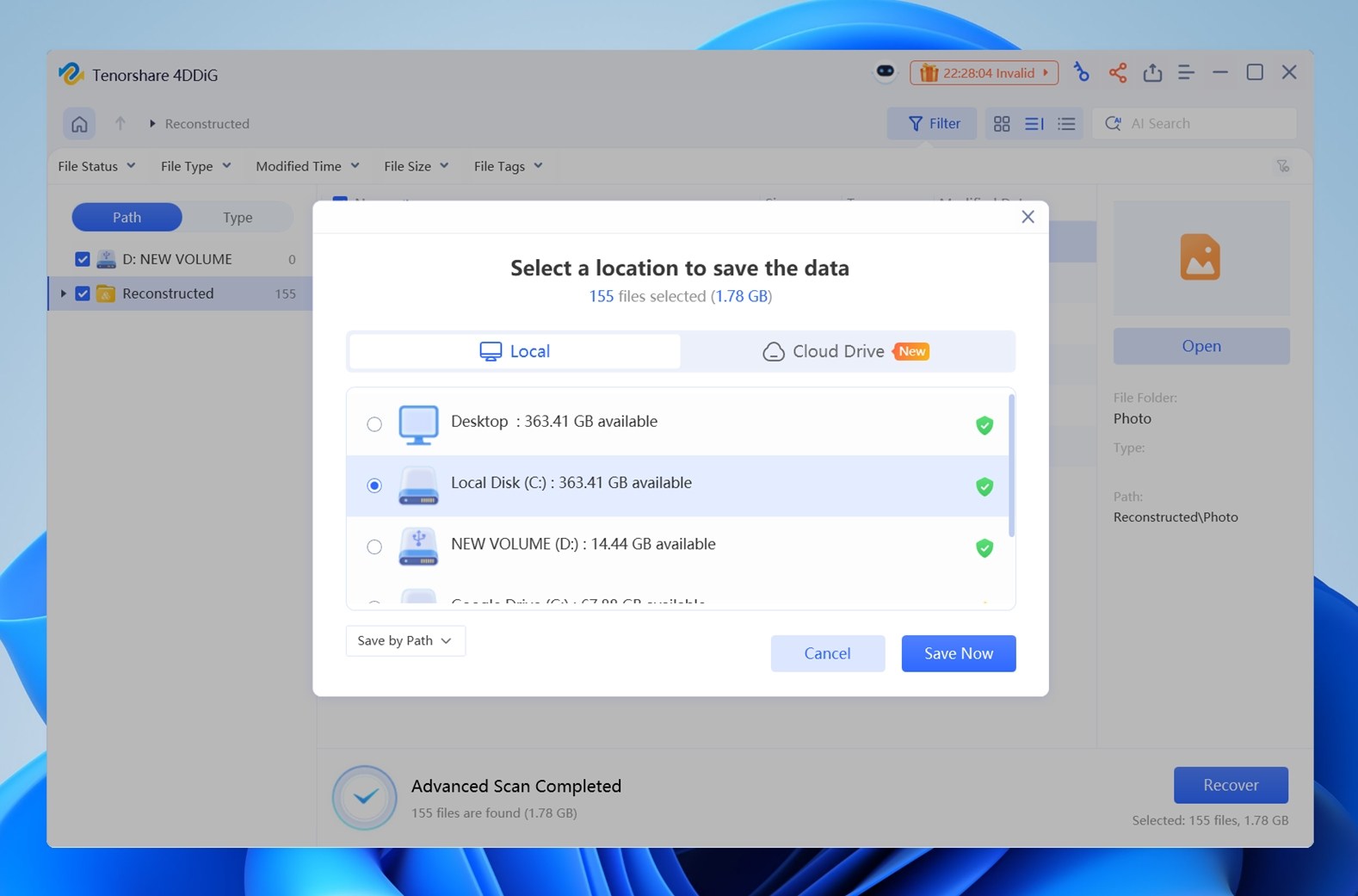
Overall, the workflow is easy to understand. Click the source, choose file types, let it scan, inspect results, preview what matters, and recover to a safe destination. Even someone new to recovery software could figure it out without much friction.
Recovery Results
To avoid wasting words: 4DDiG showed middle-of-the-road results in our testing. Not great, not terrible. It recovered a solid amount of data in easier scenarios, then showed more limits once corruption entered the picture.
- In the Deleted Files / Formatted Drive tests, it recovered around 1.92 GB (translated to roughly 185 files out of 200). That’s a respectable result. Standard office files like DOCX, XLSX, PDFs, along with common JPG images and regular media files, came back in good shape. For the kind of everyday loss most users face (accidental deletion or a quick format) 4DDiG handled itself reasonably well.
- The Corrupted Drive scenario was less convincing. Here, it recovered around 156 files totaling 1.61 GB. That is still usable, but the drop was noticeable. Some JPG files came back damaged or incomplete, and more advanced formats like RAW photos (CR2, NEF) were missing entirely in our run. That matters for photographers and anyone working with cameras.
To 4DDiG’s credit, its built-in repair tools did help salvage (some) damaged JPG files after recovery. That gave us a few usable images we otherwise would have written off. It did not help with the missing RAW files, though.
As for speed, it finished in roughly 12 minutes on a 16 GB drive, which is fine. It’s in line with many tools in this category. Not the fastest we’ve tested, but far from the slowest. We’ve definitely seen worse.
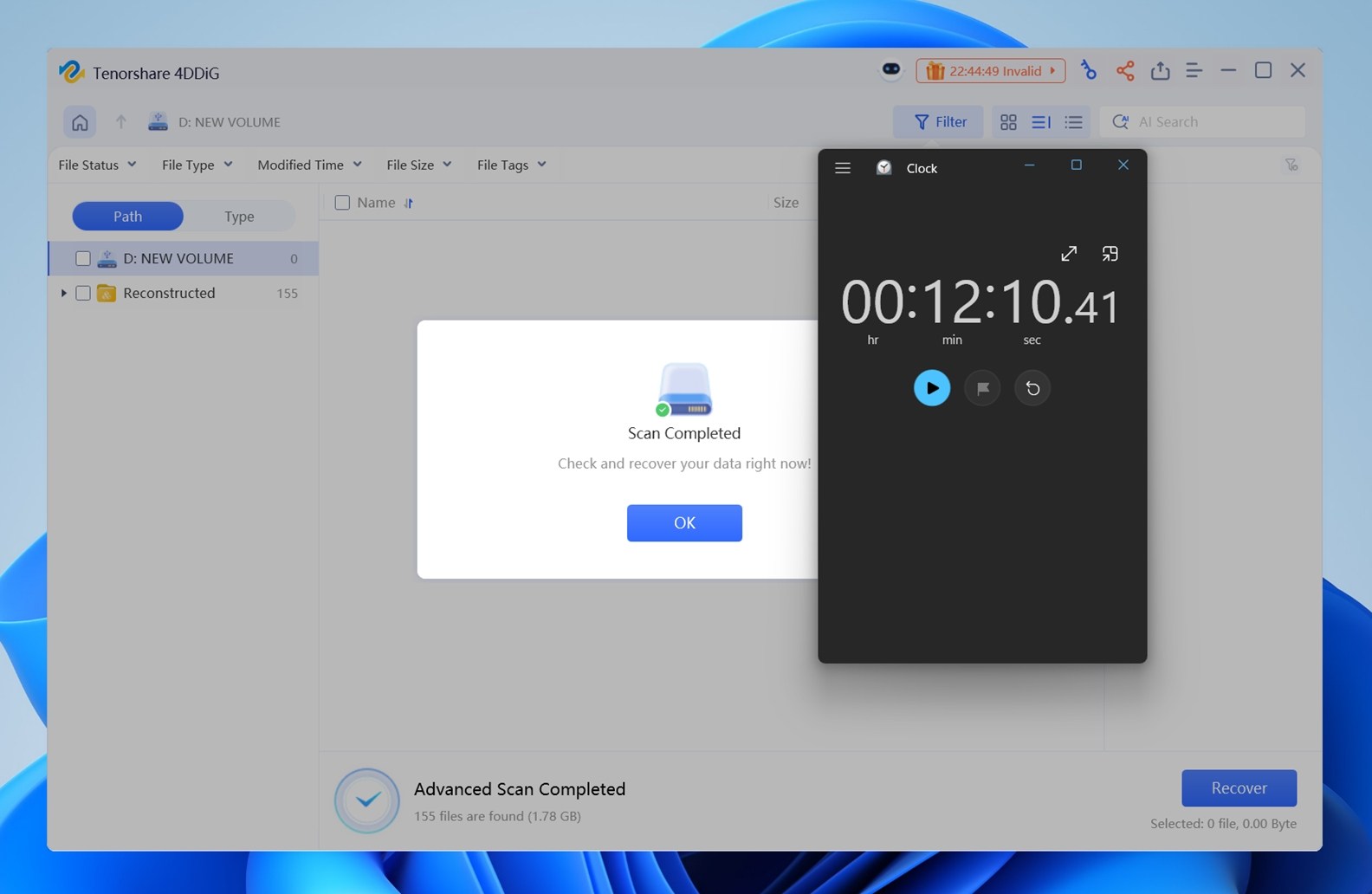
We’re giving 4DDiG a 4.0 for recovery results. For everyday recovery needs, the overall showing was solid enough to earn a strong rating.
Tenorshare 4DDiG Price Guide
Tenorshare uses a familiar tiered pricing model, with separate plans for Windows and Mac users. The good news is that you can choose between short-term access, yearly coverage, or a lifetime license. The less good news is that Mac users pay noticeably more.
For Windows, the pricing is:
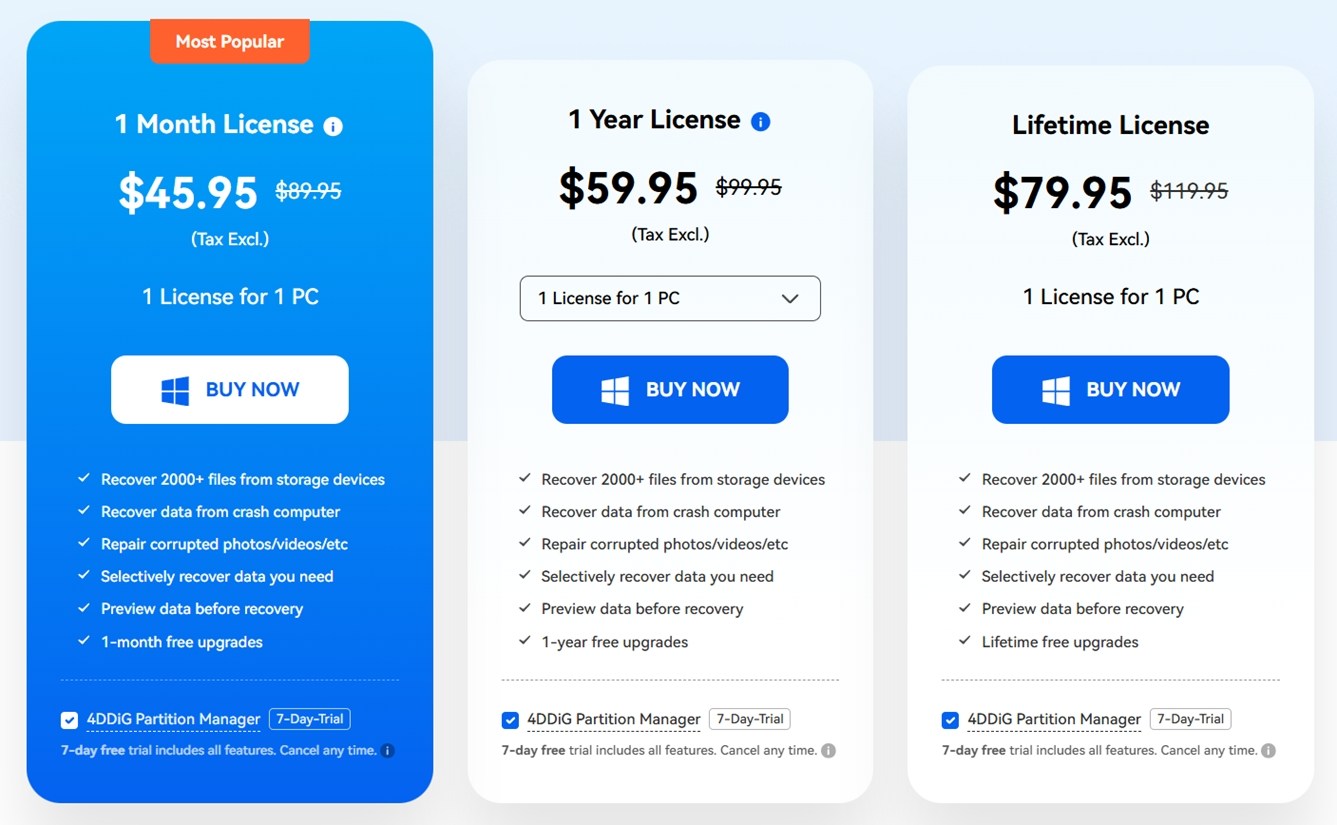
For Mac, prices are higher:
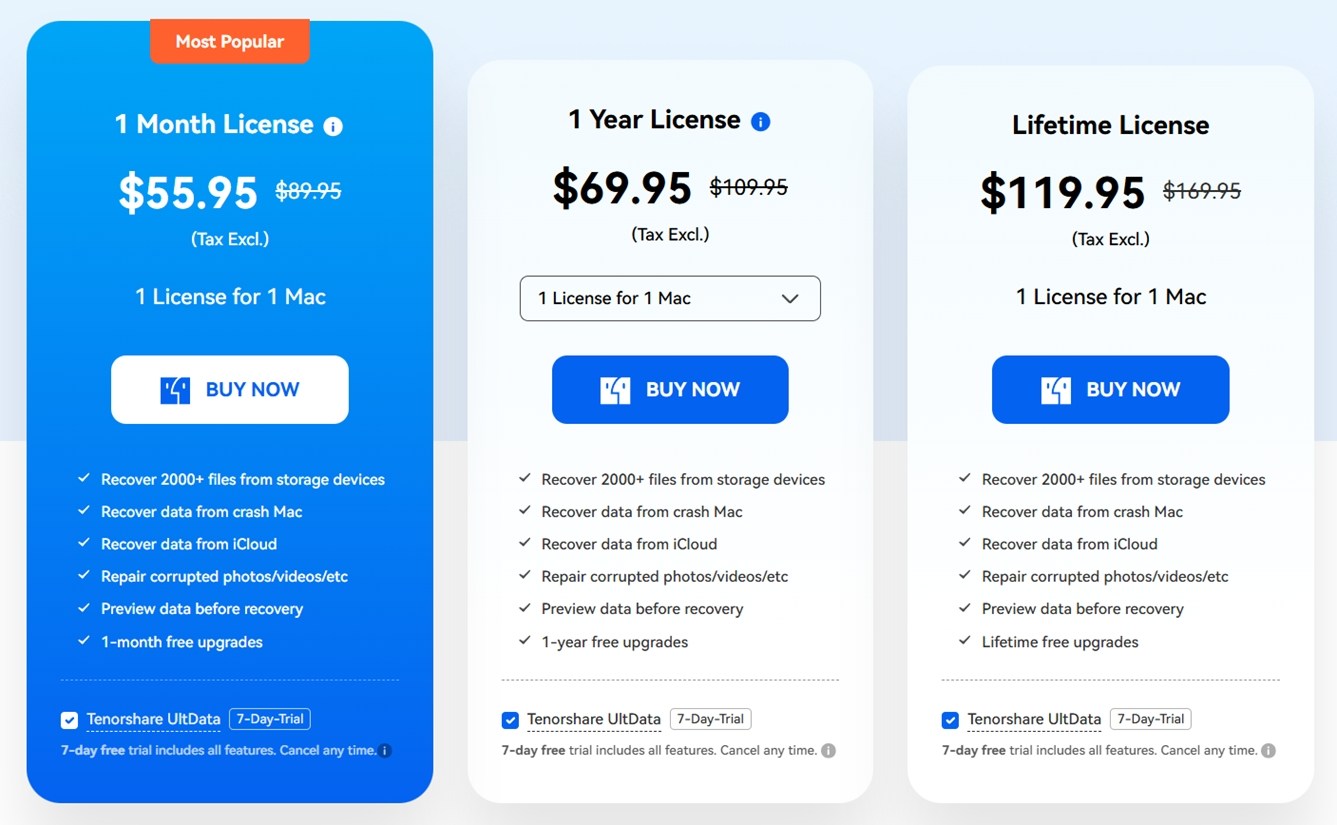
So what do you get for that money? Across tiers, Tenorshare includes unlimited recovery access, support for many file types, crashed system recovery, preview before recovery, and built-in repair tools for damaged photos and videos. Upgrade length depends on the plan: one month of updates, one year, or lifetime updates.
But prices never mean much in isolation, so it helps to compare 4DDiG against the tools most people are cross-shopping. In this category, the closest names are Disk Drill, EaseUS, and Wondershare Recoverit.
| Feature | 4DDiG | Disk Drill | EaseUS | Recoverit |
| 💰 Entry Price | $45.95/month | $89/year | $69.95/month | $105.99/month |
| ♾️ Lifetime Plan | $79.95 (Win) / $119.95 (Mac) | $149 lifetime | $149.95 lifetime | $169.99 lifetime |
| 🆓 Free Version | Scan + preview, limited recovery (Up to 2 GB) | Up to 100 MB (Windows) | Up to 2 GB with conditions | Up to 100 MB |
| 💻 Supported OS | Windows, macOS | Windows, macOS | Windows, macOS | Windows, macOS |
| 💽 File System Support | NTFS, FAT/exFAT, APFS, HFS+, ext | FAT32, exFAT, NTFS, APFS/HFS+, ReFS and EXT4 | NTFS, FAT/exFAT, APFS, HFS+, ext | NTFS, FAT/exFAT, APFS, HFS+, ext |
| 🧰 Extra Features | File repair, crashed PC, NAS, camera mode | Disk imaging, S.M.A.R.T., Recovery Vault, Advanced Camera Recovery module | Bootable media, backup tools | Video repair, bootable media |
| 💡 Best Value Take | Strong feature bundle, fair Windows lifetime price | Excellent long-term value | Good free tier appeal | Decent if you need media repair |
Looking at 4DDiG’s price alone can make it seem like a strong deal, especially the $79.95 Windows lifetime license. And to be fair, that is competitive. But once you place it next to the closest rivals, the picture gets more interesting.
- Disk Drill is the one that stands out most on value. Its lifetime license is higher upfront, but it typically includes both Windows and Mac under one license, which can matter a lot if you use more than one system or may switch platforms later. (Plus, at the moment, Disk Drill is offering a flat 50% discount.) It also tends to focus more on core recovery features like disk imaging, health monitoring, and its Advanced Camera Recovery module, which can be a major advantage if you work with SD cards, drones, dash cams, action cameras, or fragmented video files from dedicated cameras.
- EaseUS usually appeals to people who want a recognizable name and a generous free tier. Up to 2 GB free recovery can be enough for some smaller jobs, which gives it a practical edge if you only need to restore a few folders and leave. The downside is that its lifetime pricing often lands well above 4DDiG, so paid value is less obvious unless you strongly prefer the interface or already trust the brand.
- Wondershare Recoverit often prices itself as a premium option, but once you get close to triple-digit annual pricing or higher lifetime tiers, buyers naturally expect better recovery performance.
Where does that leave 4DDiG? It sits in the middle. We’d give it 4 out of 5 here as well.
Customers Reviews
And the final score in this 4DDIG data recovery review will come from user feedback. We looked through comments and ratings from places like Trustpilot, Capterra, TrustRadius, and social media to get a sense of how 4DDiG feels outside official marketing pages and controlled demos. Long-term use often reveals issues you won’t notice in a first scan.
Here are some common themes we saw in typical feedback:
Lucas F. writes:
“I was in need of a software to help me transition from Android to iOS, especially without any loss of data regarding WhatsApp, and their software was amazing: simple, elegant and with all the information needed given at the right time for any steps.”
“They were excellent with their customer service and I’ve used their product 3 times to retrieve and successfully recover important files.”
Fabian claims:
“Though it’s really expensive for what it does, their Whatsapp transfer software did make it super easy to transfer all of my chat history from Android to iPhone. Their customer support was also extremely fast to answer.”
While most of the feedback we saw leaned positive, it was not overwhelmingly so. The average rating on Trustpilot sat at 3.5 out of 5 when we checked – a mixed but usable reputation rather than universal praise.
There were plenty of 5-star reviews from users who recovered files quickly and felt the software delivered exactly what they needed. But at the same time, there was a noticeable share of negative reviews. Common complaints centered on billing confusion, subscription renewals, refund disputes, slower support responses, and cases where recovery results did not meet expectations. That split is fairly common in this category, but it still matters when scoring trust and customer satisfaction.
So taking the full picture into account, we’d give user feedback a 3 out of 5. Good enough to show many satisfied customers.
Final Verdict
Here’s a quick look at how it scored in the categories that matter most.
- 🌟 Features & Toolset Score: 4 / 5. A broad package with useful extras like disk imaging, repair tools, bootable recovery, camera mode, and NAS support. Some modules feel lighter than advertised, but overall coverage is strong.
- 🌟 Recovery Results Score: 4 / 5. Good performance in common situations like deleted files and formatted drives. More difficult corruption cases showed some limits, especially with RAW photo recovery.
- 🌟 Pricing & Value Score: 4 / 5. Competitive pricing, but some rivals offer stronger long-term value.
- 🌟 User Feedback Score: 3 / 5. A decent reputation with many happy users, though ratings are mixed enough to keep it from scoring higher.
Adding those together gives us 3.8, which feels about right for where 4DDiG lands today.
4DDiG is a capable recovery tool that does many things well and keeps the process approachable for home users. It is easy to recommend for deleted files, formatted USB drives, memory cards, and everyday recovery jobs. That said, competitors like Disk Drill feel deeper and more capable once you move past the surface. In our testing and comparison, 4DDiG often looked broader on paper than it felt in actual use. It has a lot of modes and add-ons, but some of them are not as developed as the feature list first suggests.
FAQs
Tenorshare 4DDiG is a data recovery software suite made by Tenorshare. It’s designed to help recover lost or deleted files from Windows PCs, Macs, USB flash drives, memory cards, external hard drives, and other storage devices. The software is marketed for common situations like accidental deletion, emptied Recycle Bin files, formatted drives, RAW partitions, and some corruption cases. Beyond standard recovery, 4DDiG also bundles extra utilities such as file repair, bootable recovery media, camera-focused recovery modes.
Yes, Tenorshare 4DDiG is a legitimate commercial data recovery software suite sold by Tenorshare, has an established website, active product updates, and thousands of public user reviews across platforms like Trustpilot. That said, “legit” does not automatically mean “best” or “perfect.”
The Tenorshare data recovery software is available for free download on the Tenorshare website. There is a free trial available to help recover files up to a limit. Beyond that, there are monthly, yearly, and lifetime subscriptions available for purchase.
In general, Tenorshare 4DDiG is safe to use when downloaded from the official Tenorshare website. It is a legitimate recovery tool from an established software company, not a fake or abandonware. The app is widely distributed, regularly updated, and used by many customers on Windows and macOS.
From a security standpoint, we did not see evidence that 4DDiG is not safe. That said, as with any recovery software, caution still matters:
- Download it only from the official source
- Avoid cracked versions or third-party installers
- Install it to a different drive than the one you’re trying to recover from, when possible
