


Wise Data Recovery by WiseCleaner claims to be able to easily and quickly recover lost or deleted photos, videos, documents, and other file types from most forms of internal and external storage media. This is typical of a data recovery tool, but what makes it different?
What are its strong points? And, what are its drawbacks? We’re going to take a very close look at everything in this Wise Data Recovery review so you can make an informed decision if you’re thinking about trying it.
📌 Here’s our brief summary:
Wise Data Recovery is a simple, lightweight Windows recovery tool that works best in basic situations like small accidental data loss. It’s fast and affordable, which makes it appealing for casual users who want something straightforward.
In our testing, it handled common recovery jobs reasonably well, but its limits became clearer in harder scenarios such as formatted drives or larger media recovery. Preview support was weak, advanced features were mostly absent, and overall recovery depth lagged behind stronger competitors.
Our take: Wise is a decent entry-level option.
| ✅ What we liked | 📛 What we didn’t like |
|---|---|
|
|
We’ve broken this review into a few key areas: the features Wise Data Recovery offers, how it actually performs, what you get for the price, and what real users are saying. For each section, we’ll give our impressions – and a rating on a 1 to 5 scale to help you quickly size it up. Then, at the end, we’ll bring it all together with our final verdict.
Every app review is the result of a hands-on, multi-step process run by team experts. Our QA specialists run recovery tests on real drives. Then, lab engineers verify the results to make sure every text is accurate. Experienced technical editors present the results in a clear, reader‑friendly format.
See how we test →Main Features and Capabilities Overview
First, let’s step back and look at what Wise Data Recovery claims to offer on paper. Features are where most recovery apps try to impress you first. Promises, long lists, lots of “supports all file types” language.
Wise Data Recovery takes a lighter approach than many other recovery solutions – it positions itself as a fast, beginner-friendly tool for common file loss situations: accidental deletion, emptied Recycle Bin, formatted USB drives, memory cards, and missing files from everyday storage devices.
| Key Feature | Details |
| 💻 Available Platforms | Windows 11 / 10 / 8 / 7 / Vista / XP (No official Wise Data Recovery Mac edition available) |
| 💸 Free Version | Yes, a free version available with recovery limits (up to 2 GB) |
| 📚 Supported File Types | Documents, photos, videos, audio, archives, emails, common formats |
| 🗃️ Supported File Systems | NTFS, FAT, FAT32, exFAT (main Windows formats) |
| 💾 Supported Devices | HDDs, SSDs, USB flash drives, external drives, memory cards (SD cards, SDHC cards, micro-SD cards, etc) |
| 🔍 Scan Modes | Fast scan + deeper search depending on file system/device |
| 📄 Preview | Limited support |
| 🧹 Extra Tools | No advanced recovery extras beyond the core file recovery workflow |
| 💿 Disk Image Scanning | No |
| 📊 S.M.A.R.T. Monitoring | No |
File Format & File System Support
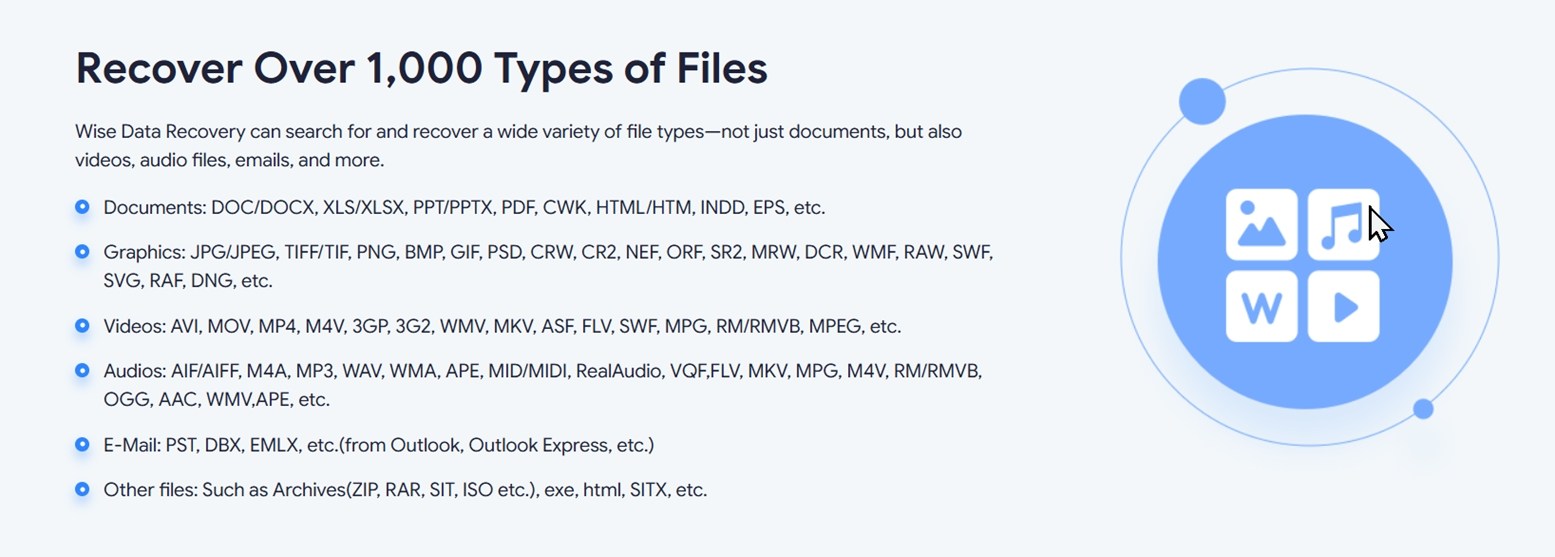
This is where Wise keeps things simple. It focuses on the file systems most Windows users encounter: NTFS, FAT32, exFAT, and related variants.
As for file types, the app covers the standard categories: JPG photos, DOCX work files, MP4 videos, ZIP archives, PDFs, spreadsheets, and similar everyday formats. Nothing unusual there – pretty much the standard marketing list you see from most recovery apps. What matters more is how well that support holds up in actual recovery jobs, and we’ll get to that later.
Storage Devices & Recovery Scenarios
No surprises here either. Wise keeps things simple in this category, much like it does everywhere else.
The software is aimed at everyday storage devices most home users own: internal hard drives, SSDs, USB flash drives, SD cards, memory cards, and external USB drives. If it plugs into a Windows PC (and shows up in Disk Management), Wise Data Recovery will likely attempt a scan.
Where it starts to fall short is in more advanced environments. This is not the kind of tool you’d reach for when dealing with NAS systems, RAID arrays, virtual disks, servers, or drives with serious file system damage. It also lacks the deeper reconstruction tools that more advanced recovery software uses in those cases.
Ease of Use & Extra Features
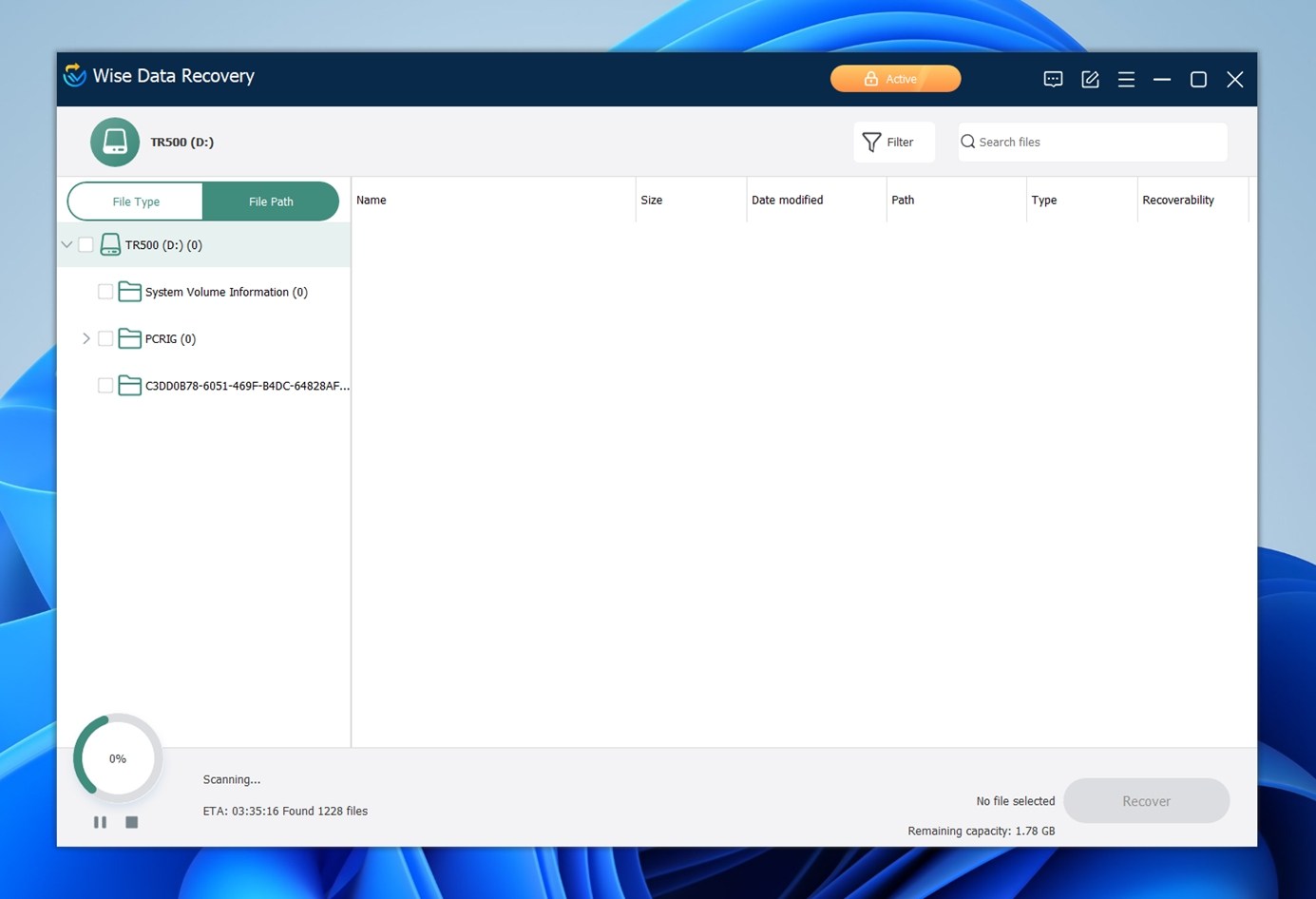
This is one of Wise’s stronger areas.
The UI is clean, fast, and easy to understand. Launch the program and you’ll usually see drives listed right away. Select one, start a scan, and deleted files begin appearing quickly. No maze of advanced settings here.
Search filters are also useful. If you only need “vacation.jpg” or files deleted today, you can narrow results fast instead of scrolling through thousands of entries.
What’s missing? Extras. There’s no disk imaging workflow, no S.M.A.R.T. monitoring, no RAID reconstruction, no forensic tools, no deep technician-style controls.
For features and capabilities, Wise earns a 3 out of 5.
It knows what it is. A simple, basic recovery tool for common Windows data loss.
We stop short of a higher score because the feature depth is nonexistent. Power users, Mac owners, anyone dealing with damaged or complex storage setups will likely outgrow it quickly.
Wise Data Recovery Test Results
Now that we’ve covered the basics and looked at the feature list, let’s move into how Wise Data Recovery performs when actual files need to come back. Specs and marketing pages are easy. This is a real test.
Below, we’ll walk through what we were able to recover in our own tests using common data loss scenarios. We structured this section like this:
- First, we’ll explain our testing process so you know what conditions the software faced.
- Then we’ll show how the tool works in day-to-day use.
- After that, we’ll go deeper into recovery performance, file quality, scan speed, and where Wise handled things well (or struggled).
Before we get into all of that, here’s a quick appetizer: a snapshot of our test results at a glance.
| Test Case | Deleted Files / Formatted Drive | Corrupted Drive |
| Scanning Speed | 10 min | 14 min |
| Total Data Recovered | ~900 MB | ~550 MB |
| Documents Recovered | ~50 usable | ~40 usable |
| Photos Recovered | ~50 | ~35 (some corrupted) |
| Videos Recovered | ~15 | ~10 (some wouldn’t open) |
Testing Process
To see how Wise Data Recovery performs, we created a few data loss scenarios that regular users run into all the time: deleted files, a formatted drive, and a storage device with file system corruption.
Our test environment:
| Component | Details |
| OS | Windows 11 Pro (25H2) |
| CPU | Intel Core i5 12th Gen |
| RAM | 16 GB |
| System Drive | 1TB NVMe SSD |
| Test Device | Kingston 16GB USB 3.0 flash drive |
| Test Data | ~1 GB mixed files |
The test data included DOCX and PDF documents, JPG and PNG photos, MP3 audio, MP4 and MOV videos, ZIP archives, and a few larger media files. Each test started with the same data set so results stayed consistent across the board.
Since this is a fairly simple recovery app, we didn’t push it into specialist territory with RAID arrays, virtual machines, or physically unstable drives. That would miss the point. Tools like Wise are usually downloaded when someone deletes files, formats a USB stick, or suddenly can’t open a memory card. Those everyday problems are what bring most people to apps like this, so we kept the testing focused there. Fair is fair.
We simulated three common problems:
- Files deleted normally and from Recycle Bin.
- A quick format of the USB drive.
- File system corruption that made Windows ask to format the device before use.
How to Use Wise Data Recovery
To get started, all you need to do is head to the official WiseCleaner website, download the app, and install it.
We tested the latest available build at the time of writing: Wise Data Recovery 6.2.2.520.
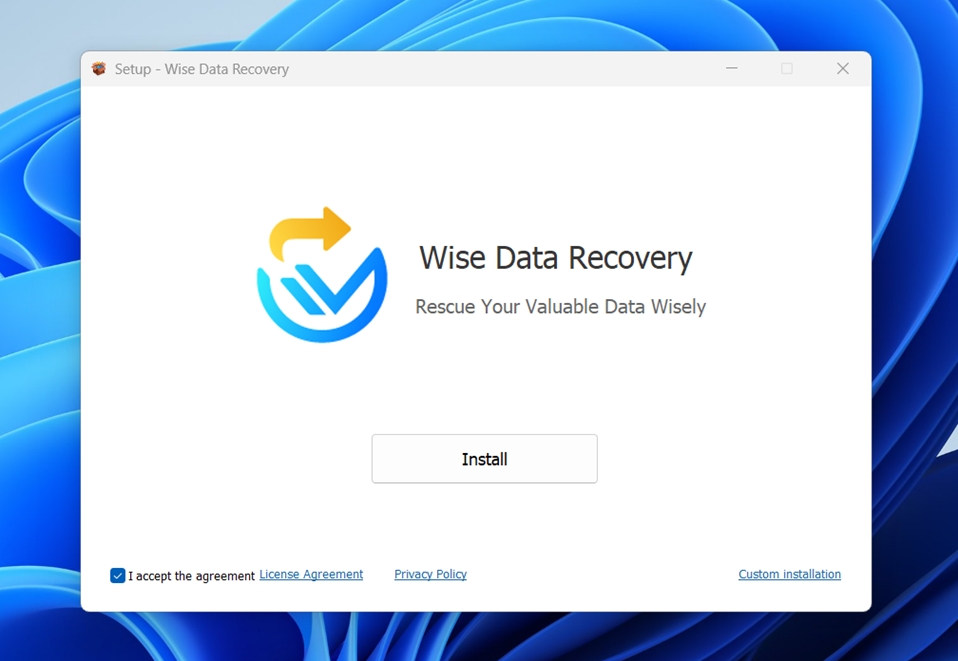
The installer is tiny. Just open the setup file, accept the agreement, click Install, and you’re in. Within a minute, the program was ready to use.
Once launched, you’re greeted by the main interface. There isn’t much to do at this stage besides select a location to scan.
Click the location box in the top-left area and choose the drive you want to scan. This part works, but we didn’t love how it’s presented. The location selector feels more hidden than it should be. In many recovery apps, drives are front and center the moment you open the program. Here, it takes an extra click and feels less intuitive than necessary.
Still, once selected, the scan begins quickly.
As files appear, the left panel starts grouping results by categories like: Graphic files, Video files, Audio files, Documents.
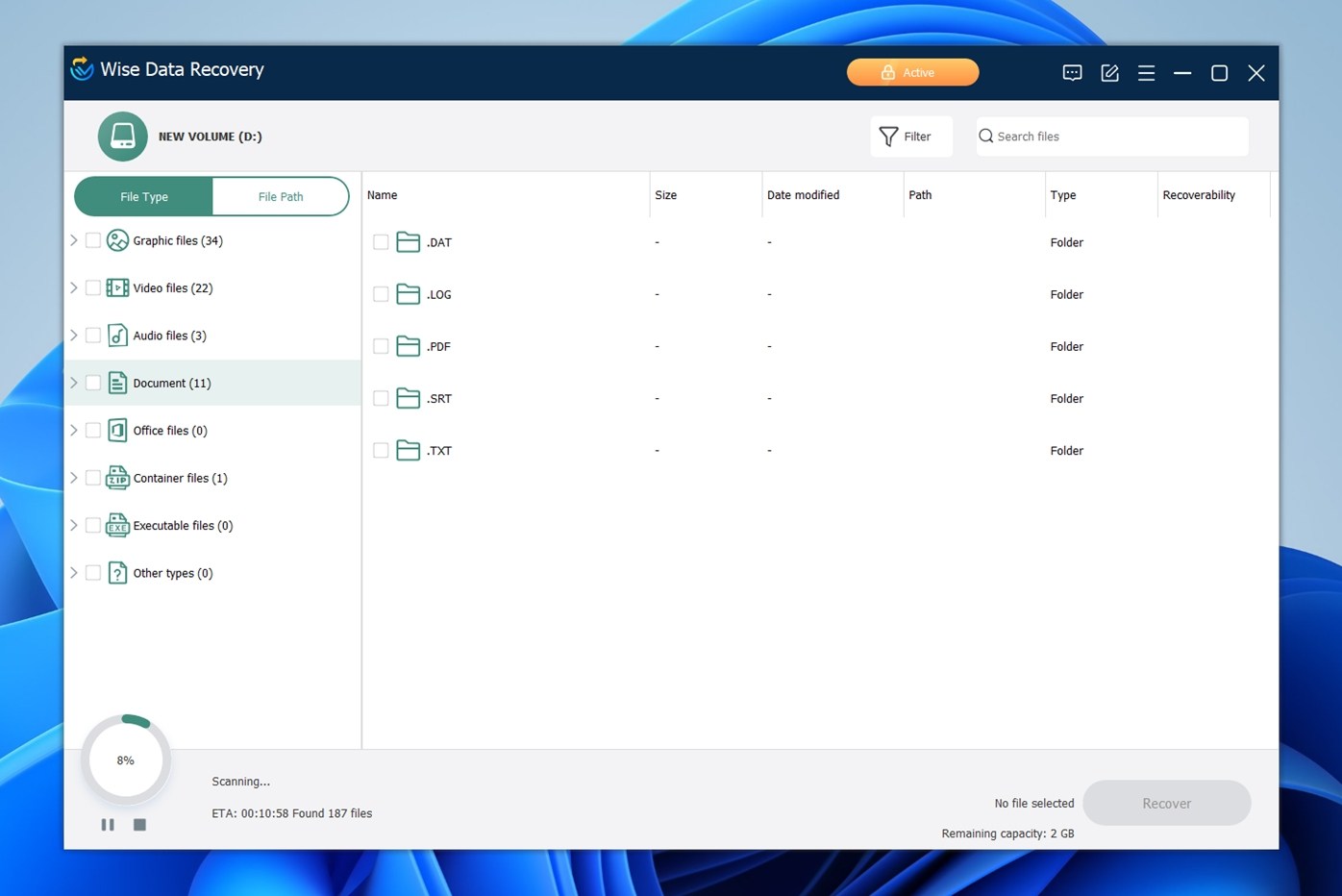
You can also use filters and search. This is one area Wise handles well. Across the top, you can filter results by: File size, Date modified, File type categories. If you know you only need JPG photos or a deleted PDF from last week, these tools save time.
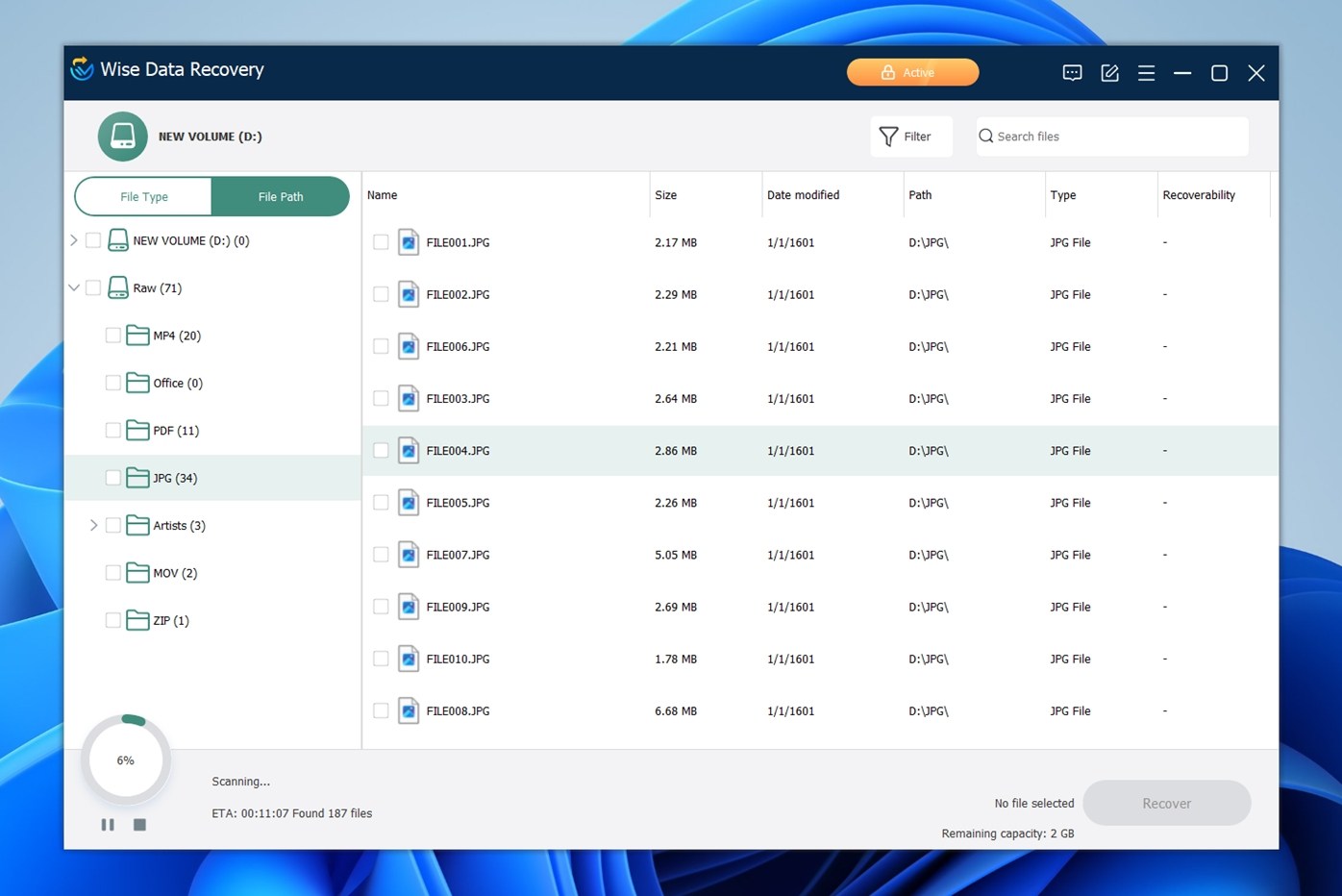
Each file gets a recoverability label. That’s helpful as a rough guide, especially for deleted files where structure still exists.
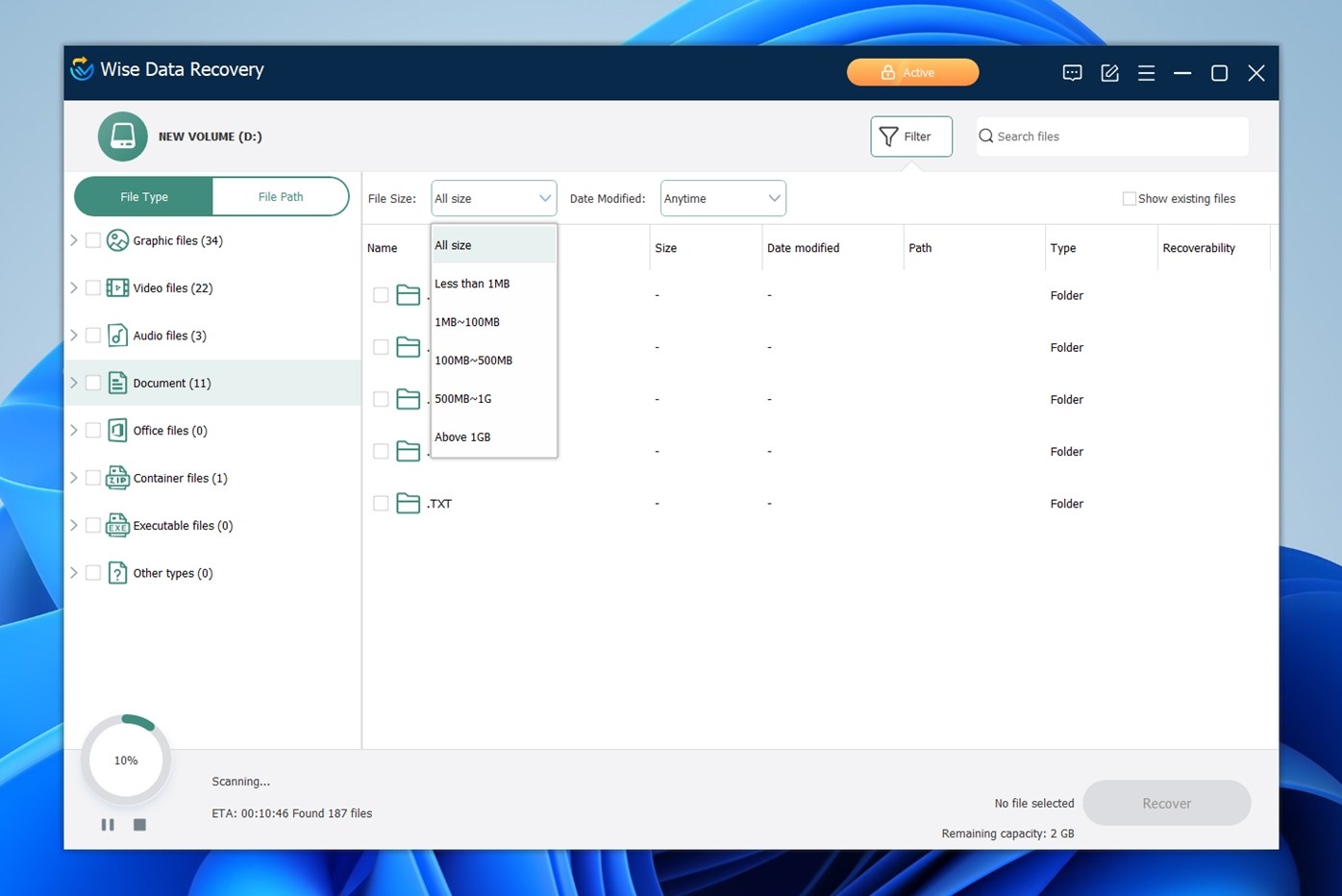
But this is also where our biggest complaint starts.
Preview support felt extremely limited. Many files either would not preview at all, loaded painfully slowly, or offered little useful confirmation before recovery. In practice, that means you often work half-blind. You can see filenames, extensions, sizes, and paths, but not always enough to confidently know whether the file is intact.
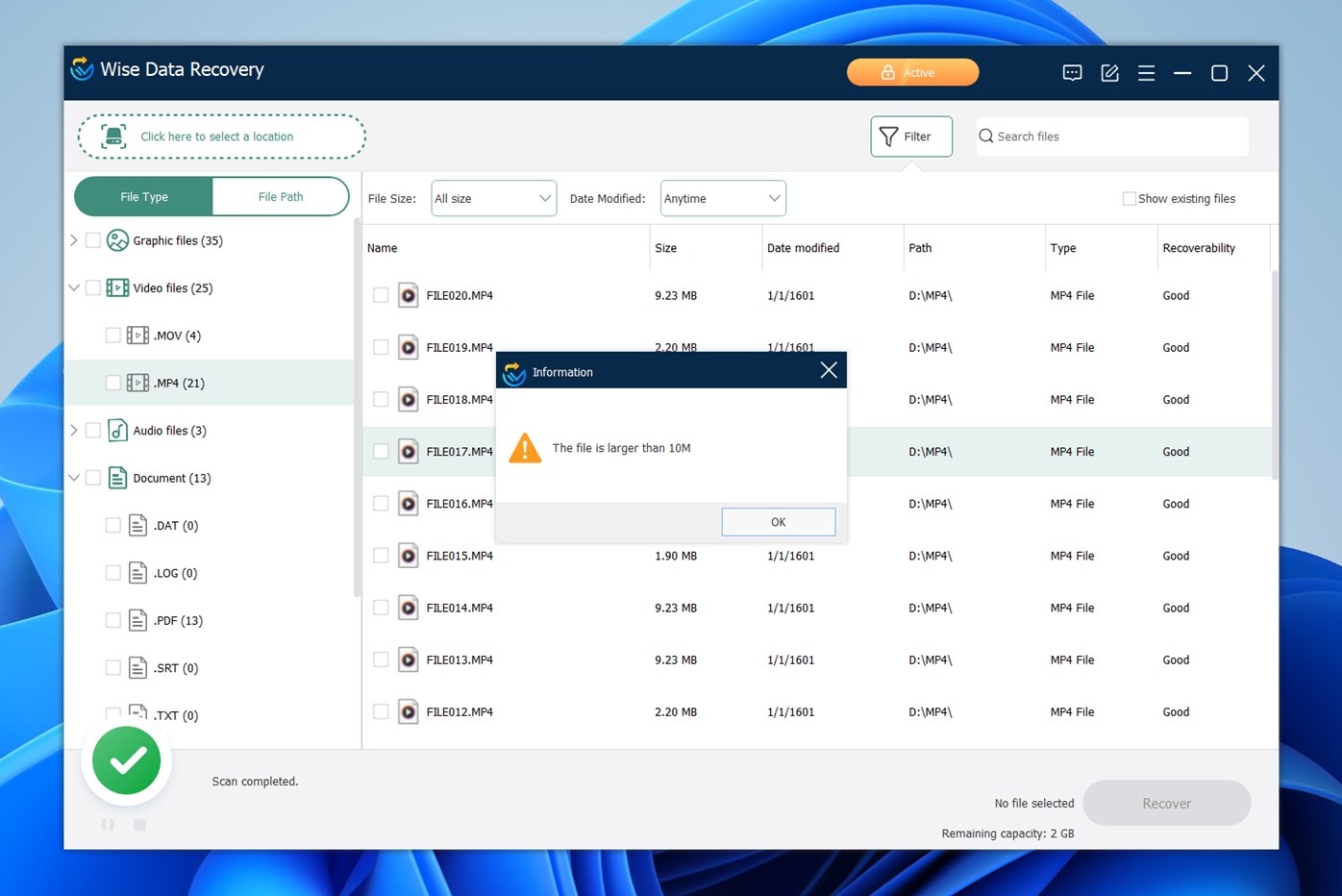
On top of that, it enforces a 10 MB preview limit, which further reduces its usefulness. That becomes even more of a problem with photos and videos. If you’re trying to recover 40 similar MP4 clips named FILE001, FILE002, FILE003, preview quality matters a lot.
Finally, all that’s left to do is to select the files you want, click Recover, then choose a safe destination folder (preferably another drive). Standard recovery logic applies here: don’t restore files back onto the same device if you can avoid it.
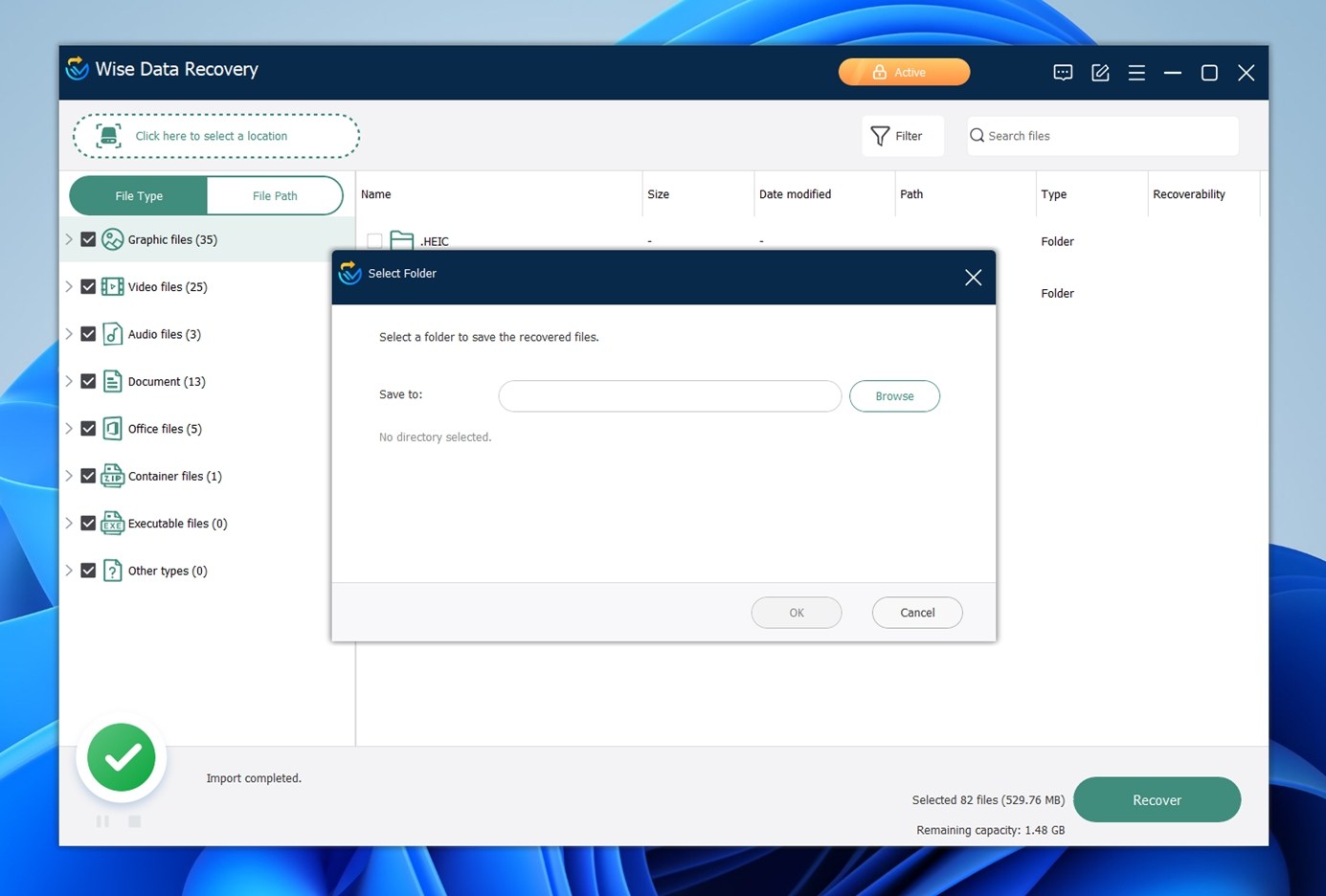
The recovery flow itself is simple and quick.
Recovery Results
The good news is that Wise Data Recovery is fairly quick. In our first two scenarios (deleted data and a formatted 16 GB flash drive), it completed scans in roughly 10 minutes each.
That’s a respectable result for a lightweight recovery tool and broadly comparable with other apps in this category.
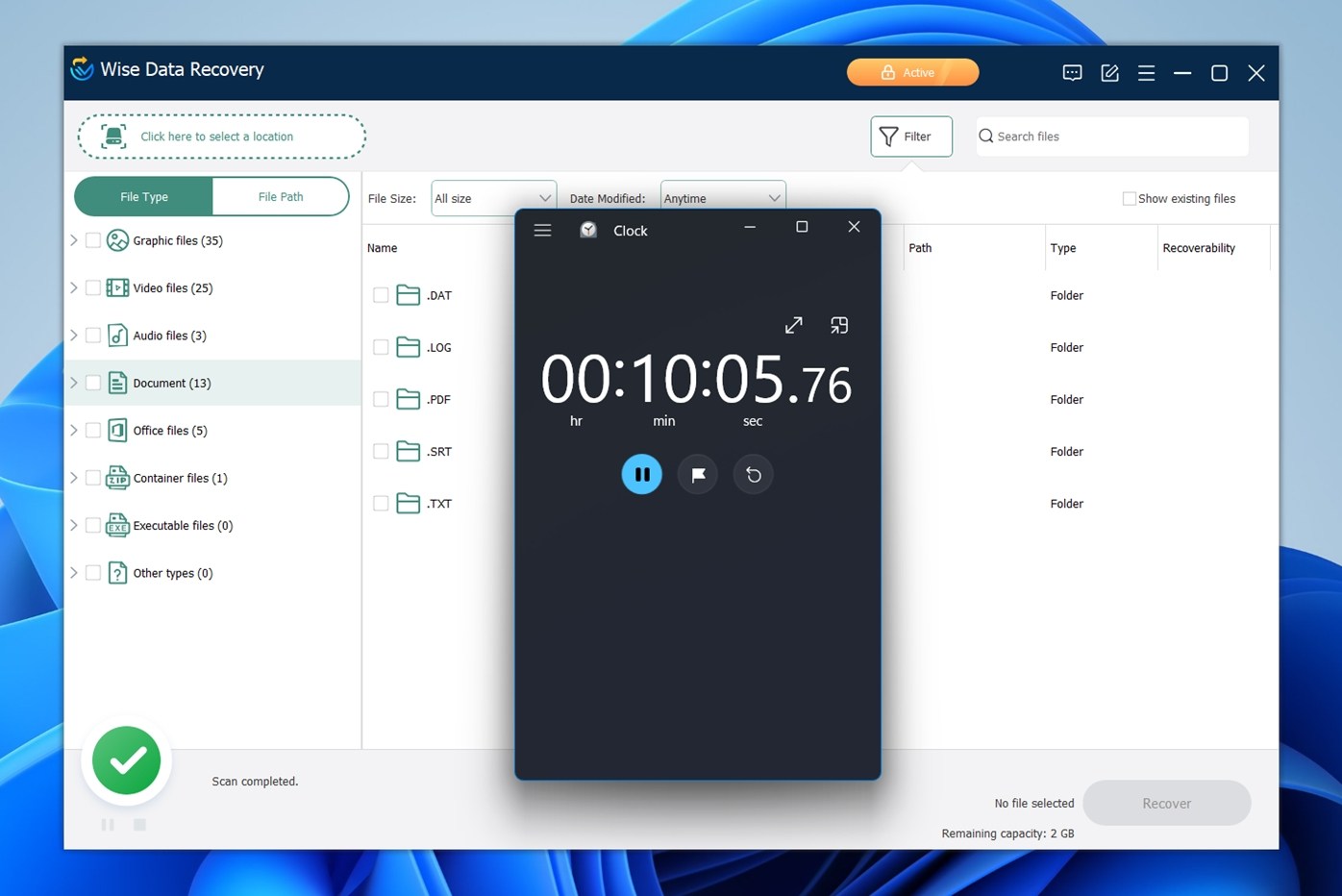
For a straightforward deletion case, the results were decent overall. Our test set included 120 files total (roughly 1 GB of data), with a mix of files. Wise found a good portion of them and handled the simpler stuff best. Most office documents, PDFs, and standard photos came back in usable condition, and kept their original names and paths.
The experience was less convincing once we moved beyond basic files. Larger media files (MP4, RAW images) were less consistent, and preview support did little to help us sort the good files from the broken ones before recovery.
After a quick format, things dropped off, which is not unusual for a tool in this class. From that same 120-file test set, recovery became far less dependable, and in our worst case the software brought back only 82 files. Some DOCX, PDF, JPG, and PNG files still survived the process, but folder structure was gone, and larger MP4/MOV video files suffered the most. A few files that showed up in results looked promising at first, then turned out to be incomplete or unusable after recovery.
For recovery performance, we’d give Wise Data Recovery a 3.5 out of 5. It handled simple deletion scenarios reasonably well. That alone makes it useful for everyday mistakes like emptied USB drives or recently deleted documents. But once conditions became harder, the results became less consistent. So we think 3.5 is a fair score here.
Pricing and Plans
Wise keeps pricing fairly simple, which matches the rest of the software.
At the time of writing, Wise Data Recovery Pro costs $49.99 for a 1-year license on 3 PCs ($39.97 for 1 PC). That is the main paid plan promoted on the official site. It includes unlimited recovery, free updates during the license term, and customer support.
There is also a free version, which lets you scan drives, view found files, and recover data with limitations.
| Plan | Price | What You Get |
| Free | $0 | Scan drives, view results, limited recovery (2 GB) |
| Pro (1 Year / 3 PCs) | $49.99 | Unlimited recovery, updates, support |
To give Wise Data Recovery’s pricing some context, it helps to compare it with a few better-known competitors. On its own, Wise looks affordable. But pricing only makes sense when you see what else is available in the same range.
| Feature | Wise Data Recovery | Disk Drill | EaseUS Data Recovery Wizard |
| 🔥 Pricing | $49.99/year (3 PC) | $89/year or lifetime option | $69.95/month, $99.95/year, $149.95 lifetime |
| 🪪 License Type | Annual subscription | Yearly or lifetime | Monthly / yearly / lifetime |
| 💻 Supported OS | Windows | Windows + macOS | Windows + macOS |
| 💸 Free Version | Yes, limited recovery (up to 2 GB free) | 100 MB free (Windows) | Up to 2 GB free |
| 🔍 Scan Modes | Quick + Deep | Quick + Deep + signature scanning | Quick + Deep |
| 💿 Disk Imaging | No | Yes | Yes |
| 📊 S.M.A.R.T. Monitoring | No | Yes | No |
| 🧰 Advanced Features | Minimal | Disk imaging, disk health monitoring, Advanced Camera Recovery feature, Recovery Vault | Boot media, repair extras |
| 👤 Best For | Simple file deletion cases | Broad home + power users | Beginners wanting guided recovery |
Wise clearly wins on entry price. If someone wants a lower-cost tool for one simple recovery job, it has appeal.
But when you compare overall value, things shift. Disk Drill costs more, yet includes Windows and Mac in one license, plus stronger extras like disk imaging, S.M.A.R.T. monitoring, and the Advanced Camera Recovery module, which can be genuinely useful for anyone working with cameras, drones, dashcams, fragmented video files.
EaseUS often costs more than both, but it still offers substantially more than Wise in terms of depth, platform support, bootable media options, and broader feature scope.
Non-profit organizations, as well as educational institutions and government agencies, are eligible for a 20% off discount when buying Disk Drill.
We’d give Wise Data Recovery a 4 out of 5 for pricing. The current promo for 1 PC keeps the entry cost approachable. And the free version gives people a chance to scan first and see if their files are recoverable before paying.
We stop short of a higher score because overall value is mixed. Wise is affordable, but competing tools not far above this price are better.
Customers Reviews
The final category in our Wise Data Recovery review is user feedback.
We looked across the web to get a broader picture of how Wise Data Recovery performs in everyday use – forums, software sites, tech communities, user discussions. Our own testing tells one part of the story, but long-term user experience often reveals different things.
TechRadar says:
“Wise Data Recovery is a good choice for file recovery if your main goal is to save recently deleted files. It works with almost every common file type and Windows file system. Wise Data Recovery is simple to use, although that simplicity may be frustrating if you’re not able to find the files you want to recover.”
John on Software Suggest says:
“One of the best free data recovery software available online. Just scan in drives or attached USB for deleted files and vola recover the lost deleted files. Interface of the software is pretty simple and does not have advanced options like other data recovery softwares do but then again most of them don’t provide this advanced options to free users.”
Lisandro on G2 says:
“Wise Data Recovery gives the files folder recovery from the FAT, ExFAT and NTFS devices. The scan is very fast and you can work while the software executes it. Pleasant and useful. The report after the hard disk scan is sometimes inaccurate and sometimes it shows as recoverable some files that can not be recovered.”
For user feedback, we’d give Wise Data Recovery a 4 out of 5; the general sentiment is fairly positive. Users often praise the software for being lightweight, easy to use, and fast for simple recovery jobs. The free version also gets frequent credit for letting people test recovery without paying first, which many appreciate. WiseCleaner as a company also holds a 4.4/5 on Trustpilot. Generally satisfied customers across its software lineup.
Where the score drops a bit is in the same areas we noticed ourselves: limited depth for harder recovery cases, weak previews. That makes 4.0 a fair score here.
Final Verdict
With the scores we gave:
- 🌟 Capabilities & Features Score: 3 / 5
- 🌟 Recovery Performance Score: 3.5 / 5
- 🌟 Pricing & Value Score: 4 / 5
- 🌟 User Feedback Score: 4 / 5
That gives Wise Data Recovery an average of 3.625 / 5, which we’d round to:
Wise Data Recovery is a decent recovery app that understands its lane. It’s lightweight, easy to install, quick to scan, and approachable for people who have never used recovery software before. If you deleted files from a USB drive, emptied the Recycle Bin, or lost a few documents recently, Wise can help.
But after spending time with it, we think most people would be better served by Disk Drill instead. It offers broader recovery depth, stronger preview tools, disk imaging, S.M.A.R.T. monitoring, better support for tougher data-loss cases, and licensing that covers both Windows and Mac. If the price difference is small (and it often is during sales), the extra capability can be worth it.
That doesn’t make Wise a bad product. It simply feels more limited.
FAQ
Wise Data Recovery by WiseCleaner is safe and legit. To avoid potential malware or false copies, always download from the official WiseCleaner website.
Yes, there is a Wise Data Recovery portable version. WiseCleaner offers an official portable download – the company’s download center lists both the standard installer and a portable edition for recent releases.
Yes, Wise Data Recovery does have a real free version, but it comes with limits.
At the time of writing, the free edition lets you recover up to 2 GB of data for free. You can install it, scan your drive, preview found files, and restore data until you hit that cap.
Not anymore. There used to be a page implying a Mac version of Wise Data Recovery, but today that page leads to a download for Stellar Data Recovery for Mac, not an actual Wise-developed Mac edition.
The Wise Data Recovery makes data recovery super easy thanks to its clean interface. Follow the below instructions to perform a Quick Scan on your drive:
- Download and install Wise Data Recovery.
- Select the drive you want to scan from the dropdown menu and click Scan.
- Click Quick Scan.
- Select the files you want to recover then click Recover.
- Specify a location that’s not on the same drive you’re recovering from. Click OK.
